By Kira L. Schlechter
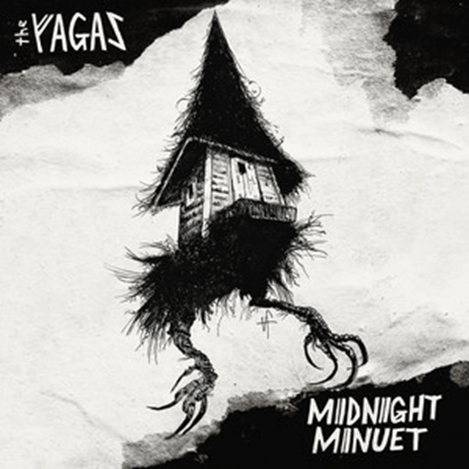
My partner on this site sends me links to songs all the time (because she’s amazing and her musical taste is impeccable). Late last year, she sent me this song from a new band:
It starts nicely enough – a jangly little alt-rock guitar melody, a creepy keyboard counterpart, a shambling groove, adding intriguing layers as it goes. The singer has a deep, sardonic, deadpan drawl in the verse and switches to an airier, wistful tone, full of sorrow, in the brief drift of a chorus.
It’s that napalm-bomb breakdown, though, where she bursts into a primal, primeval howl, clinging to the mic like a lifeline, with the band exploding around her, that grabbed me hard and didn’t let go. Then it subsides away on a variation of the same initial melody, the singer crooning it to its end. That singer is Oscar-nominated actress Vera Farmiga, and the track, “The Crying Room,” by her band, The Yagas, is about experiences her extended family has had during the war in Ukraine. Her love interest in the video is frontman Eugene Hutz of Gogol Bordello.
Plenty of other actresses have forayed into music, but none have tried their hand at anything remotely as heavy as The Yagas can be. Not to mention, she is 51 years old, god love her, and boy, could we have had a conversation.
Trouble is, The Yagas (named for the Russian folk character Baba Yaga, by the way) are about as impenetrable as Fort Knox, and all my queries – for an album stream, for an interview — went unanswered (if you’re reading this, Vera, we’d still love to have you).
Along with Vera, the band is Renn Hawkey (also of Deadsy, keyboards; he also produced the album), Mark Visconti (guitar), Mike Davis (bass), and Jason Bowman (drums).

We’ve already discussed “The Crying Room,” so here’s a look at the other tracks from The Yagas’ debut album “Midnight Minuet,” with commentary Vera provided on each on the band’s Instagram page:
“I Am”:
She says this is “about helping my Granny, ‘Baba Nadia’” who had Alzheimer’s disease, before she passed away; she had been orphaned in Ukraine and survived Russian occupation.
Similar in sound to the lead track but decidedly more metal-tinged, its repeated chorus (“Voices surround/Fall to the ground/Falling, calling/Mother save me”), as well as the agonizing spoken-word portion that ends in a cry, are indeed a poignant rendering of someone drifting slowly into madness while still trying to hold onto their individuality.
“Life of a Widow”:
She says this is “about a widow pirouetting through her angry grief, mourning like Ophelia…her beloved deceased finally appears in the outro.”
Set to a tense, echoing keyboard melody and a more-alt-than-metal feel, it’s edgy and nervy and atmospheric. Vera’s voice is full of need and unrequited desire as she goes through the stages of grief – first that anger as she almost taunts her dead spouse. “Deceased is easy like, it’s easy like one two three,” she snarls, as if to say it’s going to be much harder for those left behind.
The bridge is crushing, dissonant, frustrated, but it leads to the next stage of grief, acceptance, albeit reluctant – “I’m healing now/Believe it now/I feel you once again,” she sings, with a resigned tone.
“Anhedonia” (defined as a mental illness described as loss of interest or pleasure):
Vera says she means the word “not as a symptom, (but) as a lover…the kinda lover who shows up uninvited, eats all your joy, and somehow you’re still asking them to stay…A love letter to absolutely nothing…feeling passionate about dispassion.”
This one is almost purely goth, the guitar smirking commentary alongside Vera’s deliciously snide lyrics, so perfectly from the perspective of a mature woman who’s seen it all. “I’ll try to fake it/Try, let out a squeal for you/Oh here I come now/Here comes something real for you” – I mean, we’ve all been there, right?
The third verse is even better, and there’s almost a bit of self-hatred in there as she dispassionately observes, “There you are lurking from the shadows/You smirk to see me in my robe/You seduce me, kiss my blue eyes black/Find your way inside me.”
The first real guitar solo of the album, frantic and crazed, leads to a bridge where Vera demands to feel something, anything: “Touch me, press me down so hard/Take this void and carve it out/Pound me on the blossom floor/The way you did that time before.” Just a brilliant, brilliant track.
“Pendulum”:
She says this is “about perimenopausal mood swings and whiplash…about being tender and deranged.” I’m sure I have no idea what she’s talking about – HA.
Tender indeed at first, with soft guitar and wordless, torchy vocals, Vera begins by insisting – morosely – “I feel so happy/I know that it won’t last.” And indeed, it all goes to hell in the crashing chorus where she alternately begs, “Don’t leave me/I’m so outta control/Don’t touch me” and “Just hold me/I’m so outta control/Ah please love me/Calm me down again, that’s your role.”
There’s a bit of wryness in the bridge where she acknowledges how ridiculous, and unfair, this situation is to both her and her partner – “Your role for me, you keep me sane/My role for you, to keep us blue.” But she’s helpless to change it as she swings into that chorus yet again. It’s hard to say how wonderful it is to get mature lyrics from a mature person for once.
“Charade”:
She says this one came about “when you realize your someone is wearing a mask stitched from half-truths and practiced smiles.”
Reminiscent a bit of Concrete Blonde sonically, it’s wistful and dreamy and shimmering, Vera musing to that someone, “I wish that we/We could end this game/This perfect mystery.”
“Bridle”:
The title refers to the scold’s bridle, a medieval punishment device used on women who dared speak their minds or otherwise “disobey”; it kept their mouths shut with iron bars, bolts, and a tongue depressor, she says.
Twisty and undulating, it’s not hard to equate the imagery of this song with what’s going on now with the silencing of women’s voices worldwide. She might be asking nicely to be freed – “I feel so frail locked up … unlock me” – but there will be hell to pay later – “I yearn to scream my head off/Unleash the fire” and “I feel the rage exploding/In my prison walls.”
“Pullover”:
Vera describes this as being about an anxiety attack she had when she signed up for an adult Rock Academy (where she and the band first came together).
Blending piano and guitar, it’s almost monotonic. You can feel the anxiety; it’s lyrically repetitive, the same way your brain goes round and round covering the same ground over and over when you’re stressed. “I need to scream out, I need to shut down,” she says, and in a bit of humor perhaps to her bandmates, she says, “All of your big ideas/They’re gonna have to wait.”
“She’s Walking Down”:
She says this recalls “an awful nightmare about my child being abducted … but really she’s ascending into her power.” The accompanying video is just as harrowing.
And so are the lyrics. The heaviest of all the tracks, somewhere between death metal (the blistering guitar riffs) and The Cure (the keyboard melody), it’s an awful tale – “He found me, oh my/Now I’m his concubine … Dowry paid, I bite my tongue.” Innocence is stolen (“I’m bleeding at first meeting,” she screams in the chorus), but she gets her revenge in the end. It’s imagery to which all mothers can relate; it’s savage and cathartic.
Title track:
She says the closer is “about waltzing with dead people … all spinning together, dancing barefoot amongst the graves.”
In 6/8 time, thick and dense, it is a reminder about how our dead are with us (“I have always been here”) and that eventually we will join them (“Hold me close/Hold me down/Turn with me underground”). The trippy bridge is spoken, almost shouted; there’s a lovely bit of drumming in the swirling outro. A sober, meditative way to end.
If “Midnight Minuet” is nothing but a one-off for The Yagas, we are indeed fortunate to have just that. If it’s the beginning of a career, we can’t wait to see what’s next after this most auspicious debut, my album of the year to date.

 Heavy Hags
Leave a comment