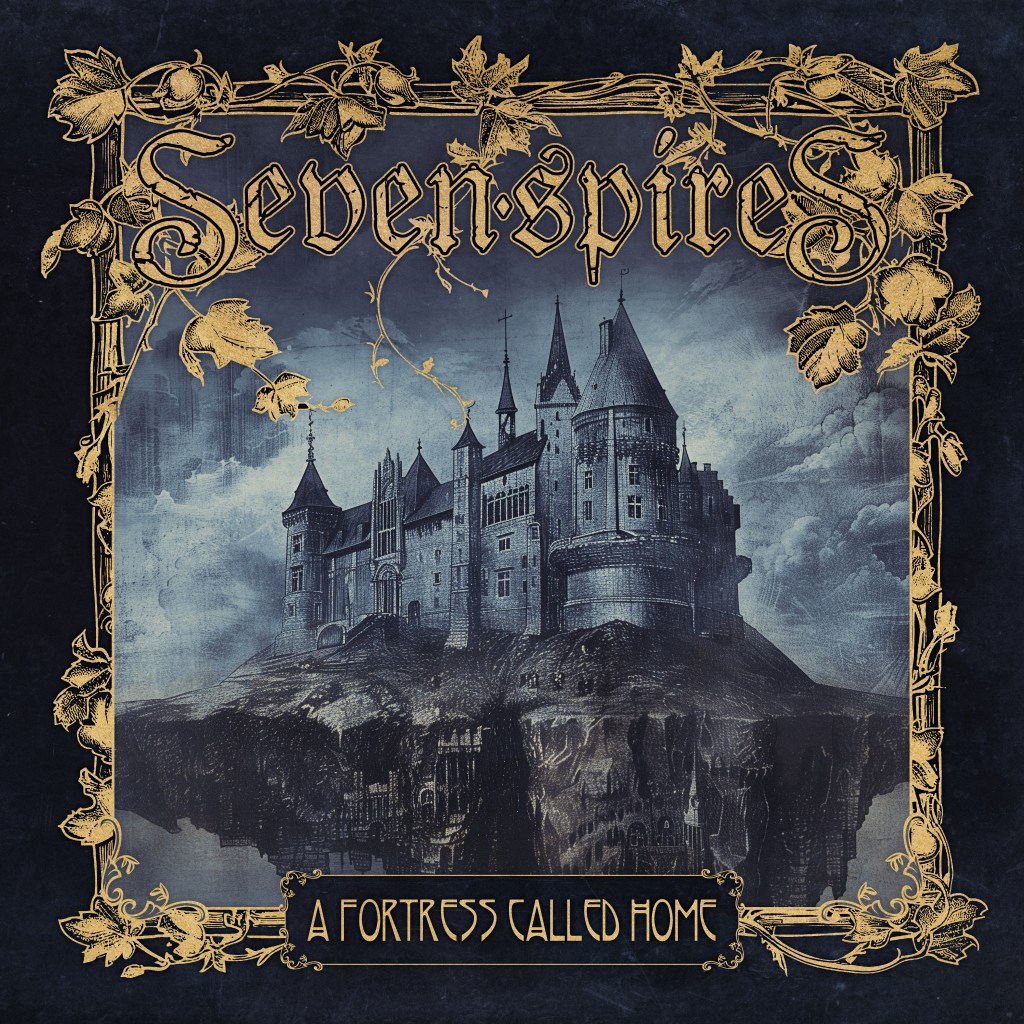
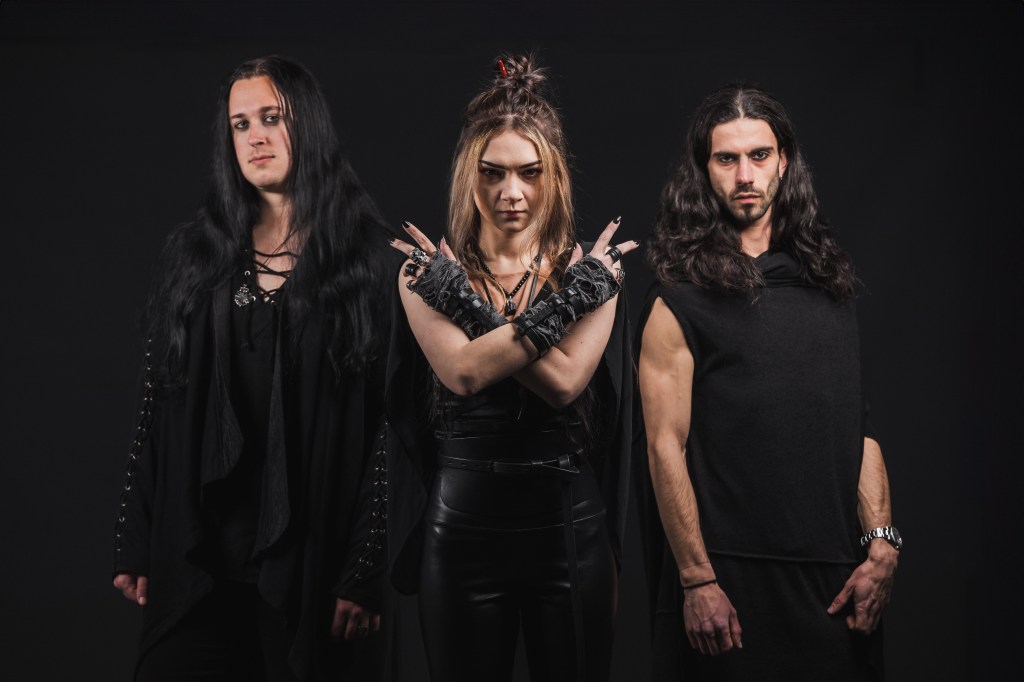
Welcome to the inaugural edition of Hags Half, where we ask our interviewees six (that’s half a dozen – get it?) questions on whatever we feel like asking! First up are singer Adrienne Cowan and guitarist Jack Kosto of the magnificent Boston-based symphonic metal band Seven Spires, who’ve just released their equally magnificent fourth album, “A Fortress Called Home” on Frontiers Music s.r.l.
I spoke via Zoom to both of them; they chimed in on each other’s answers in this lively chat. Please enjoy!
Kira Schlechter, Heavy Hags
Adrienne:
HH: You said in the album bio, “I visited the void twice while writing this album” – define the void?
AC: We’ve known each other a couple of years, and I think the state of my mental health over the years has not really been much of a secret. Since I was a teenager, or even younger, one of the ways that I was able to handle feelings or going through tough times was making music, and that is something that always stayed with me.
The first demos were done at the end of 2022. I had some tough feelings and I got through it by making music. But the album took so long – the production, the process – just took a long time to complete. So by the time it was time to do the vocal recording, or even finish the orchestration and everything, maybe I had already grown through certain things. But then to go back and finish working on those songs opened the Pandora’s box of those things – here we go again.
HH: Many songs deal with depression, or even outright despair, and to me, this goes beyond the character(s) of the album. Are you comfortable talking about where you were emotionally during the album’s creation?
AC: No, but we can try anyway! (laughs)
JK: I’ve been doing it for you! (laughs)
HH: You can’t fake emotions like this, you have to go there yourself.
AC: That’s very true. I’ve been to various different music schools and I’ve taken many songwriting classes to hone my craft. And in every single one, they tell you to write what you know, because listeners are smart, much smarter than a lot of us give credit for. I think anybody can smell inauthenticity and that’s just not what I’m about.
When I think back to those years when I was getting into alternative music and metal, I felt really alone. And I felt less like a fucked-up piece of shit just because I listened to these bands and heard that they also felt like fucked-up pieces of shit. So I write what I know, and I maybe dress it up with some fantastical mythological storytelling.
As much as I need to make art in order to process how I feel, I also want to be for others what other bands were for me back in the day. So if I can go out there and say, hey, I’m a fucked-up weirdo, maybe somebody will hear that and go, ‘Oh, it’s not just me! And you know what? She’s doing ok. Maybe I’ll be ok too. And it’s ok that I’m not ok.’
HH: And it’s ok to be a fucked-up weirdo!
AC: Absolutely, and that’s something to revel in.
HH: There are so many examples of just wonderful wordplay and imagery on this album, like:
“Down the hall, up the stairs/Most nights I spiral down” and the “stone gesture” in “Almosttown”;
That beautiful stanza in “No Place For Us”: “It has been the way of the sun/To sink and rise again/It is not to blame for the night/Nor should we discount/The beauty of stars”;
The Interior rhyme – “My mind is a museum/My bones a mausoleum” – in “Love’s Souvenir”;
And “By the sea in perpetual autumn/And smile at our dreams, ‘cause we got ‘em” – you enjoy that one, I can hear the smile in your voice as you sing – in “Emerald Necklace.”
Where were these coming from?
AC: The one about ‘the emerald necklace of Boston,’ the ‘hues of autumn, smile if you got ‘em’: in our college years (at Berklee School of Music in Boston), you had this stretch of greenery, the parks and everything, that Jack and I used to walk through.
We would go for walks and talk about like, oh we wanna do these things and we wanna go on tour with these bands, we wanna be part of the global metal scene, we wanna make the best art that we can. Sometimes I think back on those days and those were the dreams.
And now we’re doing all of those things, with those people, in those places, writing that music. And that’s why that smile’s always there because we really dreamed those things and we got ‘em.
In terms of the other lines, the ‘stone gesture/looming lonely in the sky’ is referencing another thing I experienced with Jack: (watching) the ‘Castlevania’ animated series on Netflix. The way they depict Dracula’s castle – the ‘impossible tower’ that juts out from the castle – it shouldn’t work at all, because there’s basically nothing supporting it.
If I live in a castle inside my mind, I live in the tower, that ‘impossible tower,’ that ‘stone gesture/looming lonely in the sky,’ where no one can fucking get me and I can’t get to fucking anybody either. Those are the sorts of things that inspire the imagery.
HH: Our character is on the cusp of change, it seems, in “Where Sorrows Bear My Name” and especially in “The Old Hurt of Being Left Behind.” And those final lines of the album, “Somewhere there is someone who loves you/Before and after they learn what you are,” are so poignant. Was this happening to you personally as well and can you talk about that?
AC: At the beginning of ‘23, I finally went to a psychiatrist and I was like, ‘I’ve been in therapy for years and some things are still not working. Can you help me?’ And so I got what I needed from them and I was finally able to become the person that I have been trying to be for so long.
That gave me the perspective to really understand and love myself before and after I knew who I was. But then also, the first song of the album (“Songs Upon Wine-Stained Tongues”) kind of deals with the terror of opening yourself, allowing people in but also allowing yourself out.
So the song at the end (“The Old Hurt of Being Left Behind”) is saying somewhere there is someone (or even someones) who love you even after you show your true self. As far as my personal experience, I always had such a hard time letting people in really, and I had such a hard time truly showing myself.
HH: “Emerald Necklace” is so moving, and you talked about the memories behind it earlier – can you talk about getting to that level of vulnerability, of softness, of sentimentality, what it took?
AC: I have something small that I would say about this, but I wonder if Jack would like to talk about this one?
JK: I’m ready to listen!
AC: OK. I started with the song, I think it was probably like 2 or 3 in the morning, I was staying at Sascha’s place (that’s Sascha Paeth of Avantasia, with whom Adrienne performs regularly) in Germany between tours or something, with a small bluetooth keyboard. I think I even just sang into the laptop.
It was something written alone, quietly. That is how I think the song first came about, but to go and actually replicate that, the vocal recording, maybe Jack has some ideas…
JK: From the recording, it’s sort of whatever gets the job done. I have the luxury of having worked with Adrienne for a lot of years, (so) I can usually find the right thing to open up the right emotion to get it into the microphone.
For that one, the way that (Adrienne) explained it to me, it was this overwhelming grief, of mourning something that you hadn’t lost yet but that you were going to. There’s always this horrible feeling behind anything good (laughs), you know?
So all this happy imagery is undermined by this bittersweetness. And so finding the weakness that comes from grief was a prompt for ‘sing this softly, like you’re whispering into the ear of someone you love who is on their deathbed.’
AC: Which was the case.
HH: It was?
AC: During vocal recording, within the first couple of days, I got the news that they couldn’t treat my grandmother’s cancer anymore and they didn’t know how long it would be. So the anticipatory grief, I think it’s called, was absolutely real in this case.
HH: The blending of the harsh and clean vocals, especially in choruses, is almost imperceptible – this is reflecting the character’s duality, yes, how there’s never good without the bad and vice versa?
AC: In the past, I think I instinctively used harsh vocals for a dark, demonic type of character and used clean vocals for the opposite of that. I don’t know if I still do that anymore because there were so many instances across the record where both are layered at the same time. But on the other hand, maybe it can also signify a certain balance between (having) the Soulkeeper kind of character within you, but also (having) your human side. And together, you can be the best version of yourself.
I also would say that I learned a lot of that from the Eluveitie tour that we did last year. Of course, a lot of their songs you have Fabi (Erni) singing and Chrigel (Glanzmann) screaming – or in the case of that tour, it was me and Fabi doing what we do at the same time. I found that to be so powerful, just her as this icon of light and warmth and pure humanness, and then me being the other one, that full darkness and aggression and fucked-up shit.
It was very cool to deliver my goods, but also to just watch her be her amazing self.
JK: I think it’s actually really interesting that you picked up on the balance of the two. This is a little bit of me having a creative idea of messing with the blend of what goes where as the record goes on, not only what feels right for each song, but as we go through the journey of the album.
At least from a production standpoint, I’m almost doing the opposite tonally as well. A lot of the clean vocals are mixed cold and distant and ambient and a lot of the scream vocals are mixed warm and dry and upfront, which is opposite of what we think of naturally.
We talked about it a lot during the demo stages – is this going to be clean, is this going to be screams – and it just ended up like if you took away one, it didn’t feel the same. It just had to feel correct and that was the way to do it. There are definitely some times like “Where Sorrows Bear My Name” – there’s Adrienne’s clean, Adrienne’s scream, Pete’s cleans, Pete’s screams, all blended so that you can’t really pinpoint one of them. And there’s a lot of different delays going on too, and it just creates this bed of cold, echo-ey loneliness.
HH: Since we at Heavy Hags are interested in all kinds of non-music things, including fashion, I ask this: there’s that line, “With lacquered claws, I beckon” in “Portrait of Us” – I noticed your nails in the videos for the albums and how they kind of reflect decay, a la Howard Hughes or something – can you talk about that?
AC: I think at some point I just realized that I feel like a bad bitch when I have long nails. (You can make noise with them!) Oh, I sure can! (clicking together her gorgeous translucent gold nails).
I really like the way that it changes the way that I gesture. I think it adds a certain ethereal, almost vampiric look, especially if I have – OK, I have super shiny gold ones right now, which looks great with my stage outfit – but if I have just a natural long nail, it reminds me of the way that vampires are drawn in anime and manga – it’s almost like talons in a way.
So for me visually, it helps put me in the mindset of a certain type of elegance, a certain amount of feminism. But also, vampires are drawn with these fucking things too, these images of them slashing through curtains because they’re drama queens (laughs).
You mentioned the (video) from “The Old Hurt of Being Left Behind”: I had this red lip stuff that I was using also as eyeshadow because it was like a dewy, wet look – like I was recently unearthed. So I put it also around my nails, on the cuticles, and I put eyebrow wax on top. I was thinking about how I would look and feel if I had been in a coffin for 50 years and somebody opened it back up and I was ready to find a path out of the dark. But I’m trying to walk out in the sun! Me and my fucked-up nails and old-school trad goth-inspired makeup – we’re trying (laughs), we’re trying!
Jack:
HH: So how much did Adrienne’s personal struggles (those “trips to the void”) inform your solos, especially on “Love’s Souvenir” and “Emerald Necklace”?
JK: Solos in songs are my little opportunity to musically tell my own version of the story. With “Love’s Souvenir,” for example, there’s not really any kind of fast stuff. I’m literally just playing the melody of the song – a soaring, high, deep kind of a moment that’s just a bit of a beacon of calmness in this chaotic bed of shit.
That’s kind of also how I handled the situation in real life. When someone’s really down in that well of the big bad, you can’t really do anything to pull them out of it, but you can at least show that you’re there, I’m waiting for you, come on out when you’re ready. This is sort of where my mind was at while I was writing it.
And then there’s the other part of it (that it) has to feel right listening casually from start to finish. So a little bit of a practical thing but then also very much I’m trying to stick my thumbprint somewhere. (You provide the optimism and the light)…Even though I’m the only one with the fucking flashlight, here I am (laughs).
HH: Songs like “Almosttown” and “Portrait Of Us” feel less dense arrangement wise – am I hearing that correctly and was that intentional, to have that blend of the really intricate and the more simple, if you will?
JK: Yes, but not for that reason. Those songs are very much that way because they wanted to be that way and if we added extra stuff in there … it’s not like there’s nothing going on in there, there’s a lot going on in there.
With something like “Almosttown,” the lyrics are about being alone, being in a castle far away looking down on everybody else having a good time. It sort of arranges itself based on the lyric, almost. And that’s not me – that’s Adrienne doing stuff and then I just turn knobs until nobody complains.
I’m also trying to understand how the delivery emotionally is supposed to be. Those songs are more stripped down to get the message across and not because we need a song that’s more stripped down because the other ones are crazy.
HH: What inspired the Celtic touches in “Emerald Necklace,” the whistle melody, etc.?
AC: Again, this was another thing that I loved about touring with Eluveitie was all their folk instruments. And it’s also what we love about Nightwish and other bands – it’s always been part of our musical palette; we always wrote the type of stuff that called for it. But…
JK: We also love falling asleep to Irish tavern music!
AC: Also that! Absolutely! Also, Jack said it about arranging things based on the lyric, and Boston has a certain presence of that demographic and that history, so it only really made sense to draw on that.
HH: Peter’s fretless bass on “Love’s Souvenir” and “The Old Hurt of Being Left Behind” is spectacular and I don’t think I’ve ever heard him do that – why those two songs in particular for that bass treatment?
JK: It came from Pete thinking that it would be a good idea to use that to do what he wanted to do. He’s very much the same way as me with the music in that he has very strong feelings on what kind of part or what kind of sound or what kind of thing should go where. So that’s totally his idea, his preference.
But we did have fretless bass on all the other albums. So it’s interesting you only heard it on this one. And I think he’d be happy about that (laughs).
HH: I wanted to get a briefing on the Chris Dovas situation (the drummer did play on “A Fortress Called Home”; Jack called it “his final work with us” as he’s since joined Testament):
JK: He basically made the decision to leave the band at some point last year; he played his last show with us at Mad With Power Fest. But we had written the record with him in mind and at that point in time, he still really wanted to do it. So of course it made sense to have him record all the songs and I’m glad that still worked out for his schedule. And it also ended up working out that he could do the music videos as well. It was cool that we could get that last send off for him in that way for his extremely valuable musical time with us.
HH: So what about the search for another drummer?
JK: It’s coming along…
AC: I can give the answer to that, so if that’s the wrong answer, then oops, I’ve already said it. After Dovas informed us of his decision, we held auditions. There were a few super standouts. One of them was Dylan Gowan (son of Styx vocalist Lawrence Gowan), and we invited him to join us for the Europe tour earlier this year. We loved his playing, but the thing is you might be the best player in the world but are you a cool person? And you might be a cool person but does your vibe fit our vibe?
And so far, it seems like the answer is he is a great person, he’s a cool player, and his vibe fits our vibe. There’s nothing really official to report at this point, but if things went in a certain direction, I would not be surprised … yeah. That’s where that stands.
JK: I think somebody should send the guy a job offer (laughs). And it’s completely up in the air right now. But we’re really liking how Dylan’s been with us and hope it continues.
HH: It’s tough losing a founding member…
JK: Super tough, yeah. But on the other hand, we’re just so happy for Chris and that he was able to basically move to joining a band he grew up idolizing. It’s such a cool opportunity. It’s the kind of thing as a young musician, you dream about, of joining one of your favorite bands. It’s tough for us, but it’s also we’re super proud of him and for him for doing that.
HH: What’s coming up live wise with Seven Spires?
JK: We have one show in August at Mile High Power Fest in Denver. And then we have a small tour of Japan in December, and then I believe we have one festival the following summer in Germany.
AC: We recently signed with a European booking agent who is super great. I can’t say it now but it seems likely that there will be more European dates to support the album. And we hope that there will be some North American ones too, because we’re itching and we know North America is also itching – everybody’s itching!
JK: Every comment on every post is ‘can’t wait to hear these live.’

 Heavy Hags