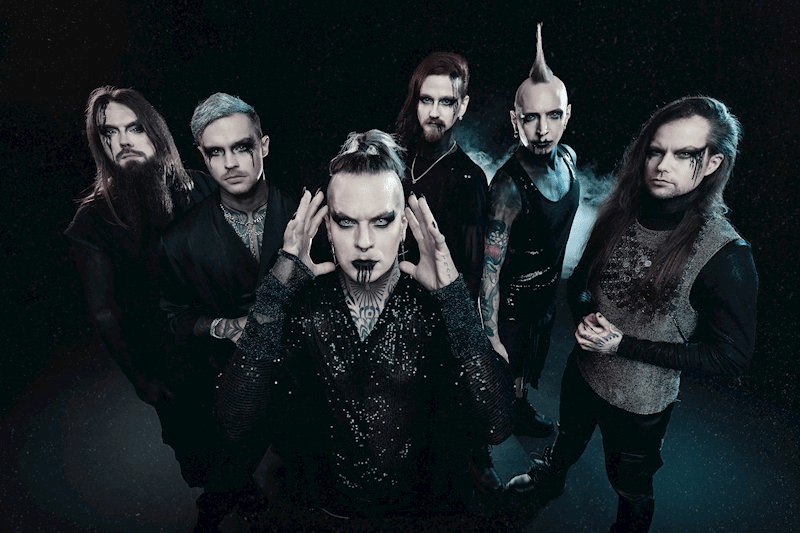
–Photo credit: VDPictures
By Kira L. Schlechter
My partner Isabell is continually amused that I’ve become rather obsessed with Lord of the Lost, who after all hail from HER hometown of Hamburg.
But here I am, and after missing out on an interview in conjunction with “Opvs Noir Vol. 2” because of the band’s relentless touring schedule, I wanted to get a review in for “Vol. 3” (Napalm Records), the wrap-up to the trilogy.
LOTL is enigmatic, chameleonic singer/guitarist Chris Harms, guitarist Pi Stoffers, guitarist/synth player Benjamin “Benji“ Mundigler, bassist Klaas Helmecke (currently on leave from the band’s live lineup), pianist/synth player/percussionist Gerrit Heinemann, and drummer Niklas Kahl.
They gained worldwide traction seven albums into their career with “Blood & Glitter” and its title track, which represented Germany in the 2023 edition of the Eurovision Song Contest. Their sound is a swirling blend of goth, metal, industrial, classical, and European pop. And the economy in their songwriting is notable – each album clocks in at around 45 minutes, but nothing ever feels incomplete or rushed.
It’s interesting how the opening tracks of each volume differ: from the hypnotic expanse of “Bazaar Bizarre” on “Vol. 1” to the pointedly political commentary of “The Fall From Grace” on “Vol. 2” and now to the just-wanting-to-hide-from-it-all plea of “Kill the Lights.” They play with tempo changes, stately to driving to light and airy, in this urging to embrace the darkness, literal or figurative, in order to heal (“sorrows seem so far/In twilight’s cold embrace”). The dark, they say, is a place to be together (“all as one unified into the night”) – you could even equate that particular sentiment to the darkness of the concert hall, where audience and performer merge to purge emotion and find joy.
As in each volume of the trilogy, “Vol. 3” is loaded with collabs. “I’m a Diamond” (featuring Alea of Saltatio Mortis) is pure positivity, the metaphor clear as, well, a diamond – “we are born raw” and we are faceted by our trials and tribulations, but beneath it all is that “shard beneath the mud … the purest part of us.” The anthemic chorus previews the statement that is the second verse, and can’t all us weirdos relate: “You tried to fit me in your frame/Your mind can only work that way/However much you looked around/In your lexicon I cannot be found/I am so much more than you describe/And I don’t care if you get it right.” Amen to that.
“My Funeral” might be the best encapsulation of what LOTL – and maybe metal fans in general – are all about. How could you not love the quirky contradiction of the chorus, “Black is my happy colour/I wear it every day/it’s black, not a shade of sorrow/I’m gonna wear pink to my funeral,” I ask you? It’s in perfect keeping with the band’s androgynous, makeup-and-nail-polish image, fearlessly wearing and presenting – in black or anything else – however they damn well please. Chris cracks wise about what others might think about wearing black: “It doesn’t mean I creep through the cemetery /And follow every hearse that I ever see/Or cackle when I read an obituary/That’s just Sundays.” It’s just a color, get over it. And it’s not even just about wearing black, either, it’s about self-expression in general, as he so cuttingly points out: “If you dress in what delights you/There are those who will begrudge/So grease your middle finger when they judge.”
The chugging, galloping “I Hate People” (featuring Wednesday 13) isn’t mindless nihilism, mind you – this is hating people who bloody well deserve it. The first half of the song is hating those who are victimized by others’ hate, those who are “being told what they are,” who are “silenced by outsiders abuse,” who fear “death for expressing their views,” who are “told who they love is a sin.” And the second is directed at those actual people – those who are “telling me what to do to conform,” who are “making martyrs from the day they were born,” who are “waging wars as the innocent mourn.” This is catharsis at its best. Let’s not forget, though, Chris says, that we ourselves have not always escaped being the brunt of someone else’s hate, as his self-reflective mea culpa says: “I’m part of ‘people’ as well/ Should I turn this hate upon myself?/I’m so sorry for the times I imposed my will/The hand that you’ve been dealt/And how it must have felt/Sorry.”
The piano-based midtempo quasi-ballad “The Shadows Within” is basically saying that our experiences, our sorrows, our shadows, are what makes us who we are and that we need to touch base with them now and then to see how far we’ve come. They keep us grounded and we learn from them, as Chris sings: “I have known them for so long, I make them stay/When I long for them I know I have a price to pay.” It’s this deeply personal, yet universal quality of the band’s lyrics and outlook (an outlook that sounds negative, but often is not) that makes them stick in listeners’ minds and stand out among their peers.
The mournful “La Vie Est Hell,” with its rollicking, rolling groove, is sung mostly in French and features Hannes Braun, formerly of Kissin’ Dynamite. His rich, resonant voice is such a nice foil for Chris’ rasp and it is given even more emotional weight courtesy of Benji’s aching piano.
“Square One,” with its mix of a repeating keyboard line and walls of frustrated guitars, is a tale of a relationship in limbo, neither here nor there, neither happily continuing or completely over – “where nothing changes in this endless ever.” Rather than angry, it’s more a mix of resigned and regretful, at a point where what the next move should be is unclear.
It’s at this point where the songs here rather mimic those on “Vol. 2” in terms of the breakdown of that relationship. “When Did the Love Break,” featuring Ambre Vourvahis of Xandria, is that next step, where the two have begun to drift apart, avoiding each other and the feelings they no longer share. Amber sings the second verse, prechorus, and chorus before they duet in the bridge and last chorus, and the futility and sorrow in their delivery is palpable without being sappy or histrionic.
The deterioration continues in “Your Love is Colder Than Death,” a swirling circle of hope (“say my name, hold my hand”) and despair (“drag me down some more”) that ultimately leads to nothing but pain.
“Take Me Far Away” (featuring Damien Edwards of Cats in Space) is the culmination of that agony, its music going from musing to pleading to thrashing, furious rage – “in the mirror, I am looking for a saviour,” Chris screams, one that he’s not going to find.
And ending as “Vol. 2” did with “Sharp Edges,” “Vol. 3” also concludes with a ballad, this time, “The Days of Our Lives.” And it’s not a happy ending. It’s vague enough to hint at both a final, very dark closure, and just the curtain call of this relationship – “how it used to be/In a world that had it all but not enough for you and me.” It lacks the theatricality and wrenching poignancy of “Sharp Edges,” but it follows the same pattern of you go your way, I’ll go mine, but we’ll always have our memories.
Taken as a whole, these three albums run the gamut of what Lord of the Lost is capable of thematically – from socio-political commentary to wry humor, from high drama to quiet despondency – and musically – from lonely piano to shrieking guitars to tense electronics. And they kind of should be taken as a whole, in many ways, rather than individually, to get the full experience. But if you’re going to listen to them on their own, each – including “Vol. 3” – stands strongly as a self-contained unit.


Leave a Reply