By Kira L. Schlechter
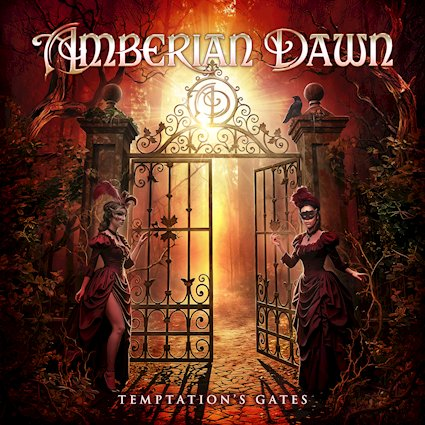
Finnish symphonic metal band Amberian Dawn has returned this summer with not only their first album of originals in six years (their last effort was the 2022 album of ABBA covers, “Take a Chance: A Metal Tribute to ABBA”), but also with a new singer and a reinvigorated sound and perspective.
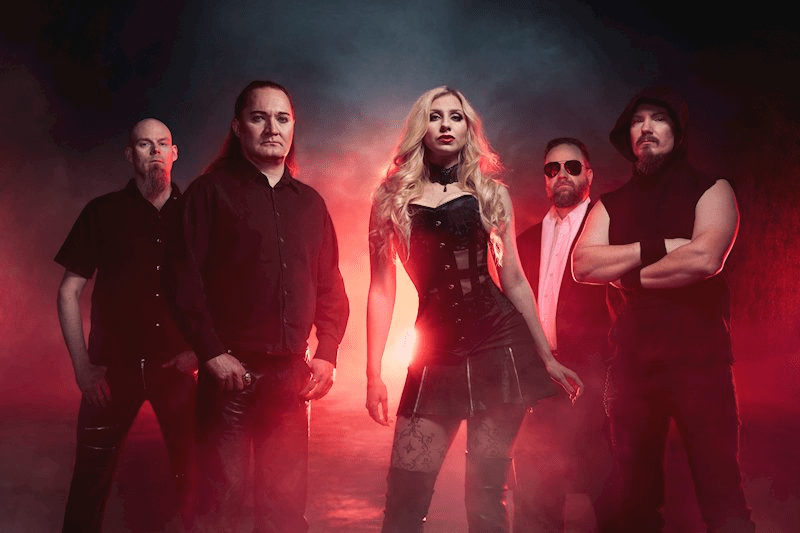
Nicole Willerton joins the veteran band for their latest, “Temptation’s Gates.” They’re led by guitarist-keyboardist Tuomas Seppälä and joined by guitarist Emil Pohjalainen, bassist Jukka Hoffren, and drummer Joonas Pykälä-aho.
She and Tuomas spoke in an email interview about how they found each other, the writing process, and the album’s songs. Our questions and their responses follow:
HH: How did you all come together, how did you find each other (the band’s previous singer, Capri, left due to scheduling reasons)?
Nicole: I was out and about when I received a message from Tuomas asking if I’d be interested in recording a cover of an Amberian Dawn song. At the time, I had been sharing quite a few vocal covers on my social media, so I thought, “Why not?” I had enjoyed their music for years and was familiar with their sound, so I decided to give it a try.
Before I even had the chance to send the cover to him, Tuomas contacted me again and explained that Amberian Dawn was actually searching for a new lead singer. He asked if I would be interested in auditioning for the role. It definitely caught me by surprise, and I had a lot to think about, but I decided to approach it with an open mind, put my own spin on the song, and see where it might lead.
I didn’t have any particular expectations, so it was a wonderful surprise when they later told me they really liked my voice. After that, I recorded a few more covers of their songs to explore how my voice fit with different styles in their catalogue. Eventually, I was invited to Finland to meet the band and join them for our first rehearsal. From the very beginning, the guys made me feel welcome. We connected instantly, got along great, and it has been an absolute pleasure working with them ever since.
HH: How much did you participate in any writing or recording, Nicole? I’d read that Tuomas said there weren’t many songs written before you joined and that the collaboration between you was really rejuvenating – would you say, Tuomas, that that was simply just having a new person to work with who had new ideas, or do you credit that to Nicole specifically, and why so?
Tuomas: When we started working on the album with Nicole, I only had a few songs ready. We began with those songs first, and Nicole wrote the lyrics and recorded the first demo vocals for them. We quickly realized that the collaboration was working really well. Nicole then recorded the final vocal parts. After that, I got a lot of new motivation, and new songs started coming together very quickly. The process was the same as it has always been with Amberian Dawn – I first create a demo version of the song at home and then send it to the singer. After that, the singer writes the lyrics for the song. Working together with Nicole was fast and very efficient.
Nicole: I received the songs one by one and wrote the lyrics during the recording process … to get the raw feeling from the vocals of what I was feeling in that exact moment. I did have creative freedom in writing backing vocals and ad-libs. It’s been a great process!
HH: Nicole, you said that a main message in the album is “embracing one’s true desires and accepting and acknowledging one’s honest feelings” – why was that idea important for you to address, and had you had trouble doing that in the past? If so, what’s changed that’s allowed you to do that more?
Nicole: So many people spend parts of their lives feeling trapped by expectations, whether those expectations come from society, other people, or even from themselves. It’s easy to suppress certain feelings, desires, or dreams because you’re worried about being judged or because you feel like you have to fit into a particular role. There have been times when I felt held back by fear of judgment and found it difficult to fully embrace what I truly wanted or how I honestly felt.
Over time, though, I’ve realized that there’s a lot of freedom in accepting yourself and living authentically. No matter what you do, people will always have opinions, so it’s more important to stay true to yourself than to constantly seek approval from others. That idea of breaking free from feeling trapped and having the courage to embrace your true desires became a natural theme throughout the album. It’s about allowing yourself to pursue what genuinely makes you feel fulfilled – accepting who you are and choosing what you love.
HH: Nicole, you said the title track is about “facing your inner desires and accepting what you truly like and want,” of “finding liberation … between who you think you should be and who you truly are” – how personal is that for you, have you had to do that?
Nicole: I can absolutely relate to that. I think many people struggle with the fear of being judged or with the feeling that others expect them to act or live in a certain way. I’ve experienced that myself at times. It has been important to learn to trust myself, embrace who I am, and be proud of the things I truly love. It’s not always easy, but I believe that accepting yourself is one of the keys to finding real fulfillment.
HH: The distinction musically between the darker-sounding verses and the brighter, optimistic chorus really drives the temptation theme home – was that intentional?
Nicole: It’s difficult to say whether it was entirely intentional or consciously planned. A lot of my lyric writing happens quite intuitively. When I write, I often listen to the music and sing ideas out loud while recording, and the words tend to emerge naturally from that process. I think the music definitely influences both my emotions and what I want to express lyrically, even if I’m not fully aware of it at the time. So while I can’t say that I deliberately set out to create that contrast, I do think there’s a strong possibility that the darker verses and the bigger and more major-driven choruses subconsciously shaped the themes and emotions that found their way into the lyrics.
HH: Nicole, you also said you love “Les Fleurs du Mal” by Baudelaire and that those poems were an inspiration for the lyrics – was that just for this song or for the whole album?
Nicole: It was mainly an inspiration for this particular song. With “Temptation’s Gates” and its almost diabolical undertones about desires, it felt natural to draw inspiration from Baudelaire’s work. I love the vibe of his poetry, especially the way he explores beauty and temptation from a darker perspective.
Human beings are complex, and it’s not always easy to admit to yourself what you truly want, let alone embrace it. The idea of being true to yourself and acknowledging what you genuinely want from life is definitely a recurring theme throughout the album.
HH: “The Vision of Dreaming” is obviously about finding that ultimate connection with someone, yes? But there’s a little twist at the end, that maybe this is a memory of something that happened and is no longer going on, like you’ve experienced it and you’re mourning its loss (“I wish those memories/Could be what I see”) – is that accurate?
Nicole: What “The Vision of Dreaming” essentially is about is indeed the deep connection between two people. As for the line you’re referring to, my interpretation is rather than mourning a loss, I see it as a desire to hold on to those memories and keep them alive. It’s about cherishing the moments you’ve shared with someone and not wanting them to fade away, because those memories are meaningful and become a part of your inner visions and who you are.
HH: I like the economy in your songwriting, nothing overstays or drags on or gets repetitive, which can sometimes happen in symphonic metal just because of its nature – can you talk about that?
Tuomas: My Amberian Dawn songs have generally been quite short. My songwriting style has evolved over the years, but the basic approach has remained fairly consistent. I’ve never really enjoyed writing long songs, and I feel that many artists artificially stretch the length of their compositions. There seems to be an assumption that a song’s length somehow correlates with the composer’s skill, that writing a long song is more difficult than writing a short one.
Maybe it’s actually the other way around. It can be more challenging to fit a wide range of emotions, moods, and ideas into a short song than into a long one.
HH: Musically, “Moon” is kind of not what you’d expect, if that makes sense – when I first saw the lyrics, I thought it would be dreamy and slow, but it’s certainly not – can you talk about that dichotomy?
Nicole: I can understand why you would think that. The moon is often associated with luminous beauty and a sense of calm, so it would be natural to imagine the song as something more dreamy.
However, “Moon” is really about remembering the beauty that still exists in life, especially during dark and challenging times. We’re constantly surrounded by news about conflicts and all kinds of difficulties, and it can feel overwhelming to take in all that is happening in the world. While it’s important to be aware of those realities, I also think it’s important not to lose sight of the beauty that exists alongside them. We need to remember to appreciate life, nature, and the things that bring us hope.
The music itself also influenced the lyrics. It has an almost folk-inspired atmosphere, which made me think about my Nordic roots and the deep connection to nature that is often present in Nordic culture and mythology.
HH: The moon is such an inspiration for women especially: we see her as healing and benevolent (“Brighten up the darkness that we are fighting to release”), and maybe in a broader way, too, she helps us keep a sense of wonder in our lives. Is that the case for you, Nicole, and was there a specific inspiration for the lyrics here?
Nicole: That’s a really nice way of putting it, and I think it connects well to what I meant. The moon really does have that mesmerizing and almost hypnotic beauty to it. It’s one of those things that can instantly ground you and bring a feeling of tranquility, just by observing it.
HH: “Unchained” is an interesting track musically, all the tempo changes, the structure (there’s no real verse/chorus thing happening) – can you talk about where that might have come from?
Tuomas: It contains many unusual elements, such as the swinging groove underneath the chorus. I can’t remember hearing many heavy metal songs with growled vocals and a swinging rhythm like that.
The rhythm also changes quite a lot between the different sections of the song. Despite that, the structure developed very naturally – it was simply the direction the song wanted to take as it evolved.
HH: Nicole, was this the first time you’d tried harsh vocals, or why did you see them as being important to use here, maybe on the specific lines you used them on?
Nicole: Actually it was something Tuomas wanted to explore in terms of songwriting. He gave me a rhythm and I created lyrics around that. I do think it works well and adds a cool twist to the song.
HH: I really like in “Eternal Flame” how the chorus spirals up and up melodically (and the overdubs in the last one are really effective) and of course the keyboard/guitar duel in the solo section – can you talk about those aspects a little?
Tuomas: The chorus really does contain a lot of variation in pitch for the vocalist. It’s technically very challenging. To be honest, I didn’t think much about the vocal technique required when I wrote the chorus. Fortunately, Nicole was able to sing it perfectly.
We’ve always used a lot of backing vocals. That’s probably one of our trademarks. The guitar and keyboard parts after the choruses are also something we’ve always done. That kind of instrumental stuff has been part of our music from the very beginning.
HH: The title is kind of a metaphor, something we need to keep burning within ourselves even while “the world” wants to “tear freedom forcefully,” if that makes sense – true? I think the second verse is all about that, ignoring the naysayers and doing what you know to be right – true?
Nicole: “Eternal Flame” explores more the idea of claiming your individuality, finding your inner fire, and refusing to let outside forces define who you are. It’s a kind of transformation from oppression to empowerment within yourself. Lines like “walking my own path” or “I never wanted to be that way” speak to the idea that there isn’t one fixed way of living or being. We all have to find our own direction in life and ultimately stay true to ourselves because we are all different.
HH: Is “Life is Art” directed at art itself, kind of like saying that creativity is the cure for “this agony,” that it helps you to “Let me feel what the meaning of this life is”?
Nicole: In a way, everything we do can be seen as art because we are constantly creating our own experiences, memories, and stories. In the case of “Life Is Art,” though, the song is primarily a romantic story about the connection between two people rather than a song about creativity itself.
The chorus melody and some of the lyrical themes were inspired by Verdi’s “La Traviata,” particularly the idea of two people being separated while still longing for one another. The song reimagines that kind of story, showing how a deep bond can remain unbroken despite distance or circumstances. Even when two people cannot be together physically, love still finds a way to endure and connect them. Of course, life itself is always a source of inspiration for art, and emotions such as love and longing.
HH: “This Night is Waiting For Me” is kind of an anticipatory feeling, yes, this situation hasn’t happened yet but it’s waiting, it’s pending – was there a certain inspiration for this one?
Nicole: It was inspired by the experience of being about to meet someone from the other side of the world, someone I never thought I would actually get the chance to meet in real life, even though I had wanted to for a long time. For a long time, the idea of meeting that person existed only in my imagination, almost like a dream or a fantasy. Then suddenly it became real, and the song captures that feeling of that dreamy anticipation.
HH: “Undying Colours” is an interesting ballad in that as much sorrow as it’s describing, there’s also optimism and forgiveness, and those “undying colours” will remain bright and vivid no matter what’s happened – true?
Nicole: “Undying Colours” is a difficult song for me to listen to, because I wrote it during a period when I was going through the painful process of separating from someone who had once been very close to me. At its core, though, the song is not really about loss. I often think of it in a way similar to the Death card in Tarot – not as an ending, but as transformation. Something may come to an end, but that ending creates space for something new to begin.
Just as the death of a caterpillar becomes the birth of a butterfly, our experiences and relationships evolve into new forms. That’s what the “undying colours” represent to me. The love was always there, but the palette of colours and emotions will be different. The line “my healing heart will forgive me” is about accepting the pain and that eventually what has been sacrificed will become part of the story, rather than something that carries sadness.
HH: There’s a real Garden of Eden vibe with “The Garden,” with the imagery of the chorus (“a hunger breaking free/A forceful sin we cannot flee/There is a beauty born in pain/And our desire is to blame”) – was that what you were going for here, and if so, what got you thinking about that?
Nicole: I see what you mean! I was also inspired by the work of the novelist Mirbeau when writing the lyrics. “The Garden” is about human souls trapped within a controlling and restrictive world – metaphorically represented as a garden – where desires continue to grow and bloom despite the limitations imposed upon them. It’s highlighting the intertwined beauty and pain of passion.
“The Garden” is closely connected to “Temptation’s Gates” – both deal with the struggle to embrace and reach for one’s deepest desires.
HH: And the closer, “Phantasmagoria,” is basically being at a crossroads, of dealing with the past and wanting to go forward, but not being sure what that entails or how to do it – realizing that the phantoms and the ghosts and the obscurity are ionly distractions and not permanent?
Tuomas: “Phantasmagoria” explores the struggle of navigating the shadows of one’s own mind, where memories and emotions once felt create haunting nightmares that distort reality. The song reflects the tension between feeling trapped in your own experiences and yearning for release, clarity, and a guiding light to find a way out of the nightmare.
Nicole: Yes, I think that’s a very valid interpretation. For me, “Phantasmagoria” is about getting lost in the shadows of your own mind, where memories, fears, and emotions can start to take on a life of their own and distort reality. It’s that feeling of being trapped in a nightmare created by your own thoughts, while at the same time desperately wanting to break free from it.
The song is really about that struggle between feeling stuck in those experiences and searching for clarity. So in that sense, it is about confronting those “phantoms” and finding a way through them rather than letting them control you.
Tuomas closed the interview by talking about a few of the band’s touring plans – their album release show was June 28, a club gig at On the Rocks as part of the Tuska Official After Party in Helsinki, Finland.
“We are also planning for 2027 and hope to put together some touring opportunities for that year,” he said.
–Photo credit: Kanerva Mantila
 Heavy Hags
Leave a comment