By Kira L. Schlechter
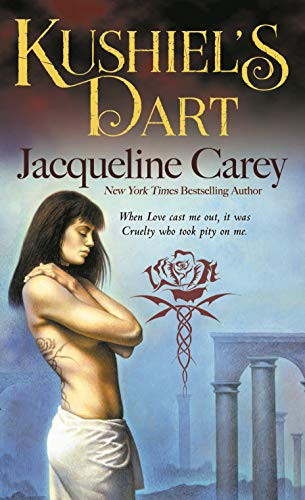
As our mission statement states, we here at Heavy Hags will tackle any subject that suits our fancy. When it came to my attention that this year marks the 25th anniversary of the release of one of my favorite books ever, “Kushiel’s Dart,” I wanted to celebrate by speaking to its author, Jacqueline Carey.

Photo courtesy of www.jacquelinecarey.com
The beloved book, released in 2001, begins the Kushiel’s Legacy series, a total of 10 books in all.
Set in Terre d’Ange, the “land of the angels,” based on France (and in other locations based on various European countries), “Kushiel’s Dart” is told from the first-person perspective of Phedre no Delaunay. “A whore’s unwanted get” (self-described), she is sold by her mother into one of the houses of the Court of Night-Blooming Flowers, Terre d’Ange’s sanctioned system of sex workers.
Now before we get all hot and bothered, let’s back up a little and explain:
Terre d’Ange was founded by Blessed Elua, a god born from the blood of a Jesus-like figure, Yeshua ben Yosef, mixed with the tears of the Magdalene and “nurtured in the womb of Earth,” as Carey writes in a later book, “Kushiel’s Avatar.” He had Eight Companions, who left the One God to follow him. Elua’s main tenet to his believers is “Love as thou wilt.”
The two Companions who factor in Phedre’s life most profoundly are Naamah (goddess of love and sex; in her, all forms of pleasure are sacred) and Kushiel (god of punishment and redemption through pain). So the Court of Night-Blooming Flowers is where Naamah’s worship – and all forms of consensual physical love – is practiced and celebrated.
As Phedre matures, it is discovered that she is the first anguisette born in many generations – one who derives ultimate sexual gratification through pain and whose existence “redresses an imbalance in the world” (a quote taken from a later book, “Kushiel’s Scion”). This attracts the attention of nobleman Anafiel Delaunay, who purchases her bond-price (to later free her from the house) and who ukltimately trains her to be a spy.
Another notable figure in the D’Angeline pantheon is Cassiel, one of the Eight who followed Elua through his travels across the Earth – he believes himself to be damned for abandoning the One God. He is celibate and demands such of his followers, his Brotherhood, including Phedre’s protector (and later romantic partner), Joscelin Verreuil. More on him later.
Carey, 61, was born in Highland Park, IL, and attended Lake Forest College, where she earned bachelor’s degrees in English and psychology. “Kushiel’s Dart” was her debut novel.
“It’s not the first one that I’d written,” Carey clarified in a phone interview. “I have a good three novels that will never be published. With every rejection, I kind of pushed myself to stretch further, be better, be a better writer.
“This was kind of my make-it-or-break-it book – it was a big concept, it was a scary concept. I wasn’t sure if it could be done, if it should be done. But I decided, alright, this is it, and if this does not sell, then I would have gone back to grad school and probably pursued psychology,” she said.
The world-building, the alternate Europe, she creates in the book “started with a conjunction of two things,” she said.
“One being the fact that I had read the book “Holy Blood, Holy Grail” (by Michael Baigent, Richard Leigh, and Henry Lincoln) a very long time ago, when I was probably in my teens. This nonfiction book … essentially lays out the theology and the history supporting the belief that in fact Mary Magdalene did make landfall in Provence and had a child who was the bloodline of Jesus Christ,” she said.
“All of that was in my subconscious when I traveled to the South of France and spent a couple of weeks bopping around and really fell in love with the quality of the landscape and the light and this history, theology, landscape. (It) all kind of conflated into, oh, I could build a world here,” she added.
The religious pantheon of the book, the Eight Companions, “comes straight from apocrypha,” she said.
“They are actually all drawn on angelology. The book of Enoch details this idea that there were fallen angels who taught many secrets to men and then God was like, uh-oh, too much. So that part I drew directly on. And then Elua himself was kind of the idea of merging the celestial hierarchy with the more hedonic tradition of a Dionysian wandering fertility god and bringing heaven and earth together in a literal sense,” she added.
Bringing Naamah into the mix, she said, was to add a female figure of divinity – in the mythology, Naamah offers herself to the King of Persis to free Elua from bondage and sleeps with strangers to support him in his wanderings.
Needless to say, and with all this in mind, “Kushiel’s Dart” may not be a book for everyone. There’s a good bit of suspension of belief and acceptance that has to occur before you can be comfortable with what’s happening.
“The initial reaction is offset, as one reads, by the realization that we are viewing this through the lens of a culture that legitimately regards sex as a sacrament,” she said. “Once that locks into place, it does change the perspective. But I never intended these to be wholesome. I don’t know if it’s any less shocking now than it was 25 years ago – it shouldn’t be.”
The book, as well as its two direct sequels, are written in first-person, from Phedre’s perspective. Carey spoke about how that affected her in the writing process, particularly in some of the more harrowing scenes.
“You talk about suspension of disbelief – you have to suspend identity in a sense as well to write that intimately,” she said. “In a way, I almost feel like I can’t address it for ‘Kushiel’s Dart’ because it gets so much worse in the final volume of the trilogy (‘Kushiel’s Avatar’).”
(Trust me – it gets a hell of a lot worse in that last book.)
So how much of Phedre is in Carey and vice versa?
“Not something I have a real good answer for,” she said. “I’m a researcher, I’m a plotter, I do not start writing until I have a really solid idea of what the structure of an entire novel is, and possibly more than that.
“However, for me the one mystery with a capital M is where do characters come from, and I do not know the answer to that. I do know that from the very first arc of inception, Phedre, her nature, was what it was – she was an unabashedly, divinely-touched masochist. I am not. I also don’t think I have the nerve to make a particularly good spy. But I am quite clever and observant, so there’s that,” she added with a chuckle.
Phedre is a unique character in fantasy in that for one, she is uniquely, unapologetically herself – she never tries to be anything other than that. She has no magic or superior abilities. She is adept at mastering languages. She pays attention, as her mentor Delaunay taught her. She’s intelligent and resourceful and repeatedly underestimated, to the peril of many.
“I think those are the qualities that make a really excellent spy,” Carey said. “Her character from that first inkling, as I said, was kind of a terrifying idea: am I actually going to write a masochistic female heroine epic fantasy? Is that a thing that’s even doable?
“It was a question of subverting what we think of as the usual tropes to find the ways in which she is deceptive. She is patient, yielding – those are not strengths we traditionally see on display in somebody who is saving the world,” she added.
Or as Phedre describes herself in “Kushiel’s Avatar,” it is “an odd legacy of Kushiel’s dubious gift that taught me to yield without surrendering. Endurance, and love – those things were all the power I’d ever possessed.”
And ok, yeah, Phedre is a courtesan, after all, a servant of Naamah, so there’s sex in the book. A good bit. But it’s not the main focus, nor does she use it at every turn. She does it as part of that service to her goddess. She does it out of love. And at critical points, she does it in order to survive.
“The theology of Terre d’Ange is very much centered on Blessed Elua’s precept, ‘Love as thou wilt,’” she said. “People take that often to be a statement of license – it’s actually a commandment as well: ‘To Love.’
“And if you buy the idea that love has divine agency, that is her superpower. The ability to find an element to love in all of these encounters, one way or another, is the lever that moves the mechanism of the plot,” she added.
“Love as thou wilt” is one of three big philosophies of not only “Kushiel’s Dart” but of the entire series. Devoted fans have turned each of these into tattoos. Each is at the root of, or can be traced to, many, if not all, of Phedre’s decisions, actions, and choices (and actually maybe all of the characters in one way or another).
Carey spoke about them, beginning with the first:
–“Love as thou wilt”: In keeping with this one, monogamy in this world is not a thing to be aspired to; it’s neither encouraged nor discouraged. Joscelin and Phedra have a relationship, yes, but she is first and foremost a Servant of Naamah and he understands this.
“D’Angelines do pay attention to this because they have human concerns about succession and inheritance,” Carey said. “But by and large, monogamy is considered a little peculiar, because why would you? It’s just not viewed as a societal necessity.”
Carey has said on social media that the “default” of the book is bisexuality. She herself is bisexual and many of the characters, including Phedre, have liaisons with both sexes, for reasons political and personal.
“With D’Angeline culture – I was really thinking about that after writing that – one of the things we see is none of the Abrahamic religions have a whole lot of sway,” she said. “The major force that has condemned homosexuality as sinful does not exist in this world.
“Instead, the D’Angelines (make) quite a few references to (and have a) certain affection for ancient Greece. So they’re looking at a throughline where the highest form of love might be, say, Achilles and Patroclus. So when you sidestep the contemporary attitudes and make it more palatable, it feels more natural in a fantasy setting,” she added.
–“All knowledge is worth having”: This is a tenet drawn from Phedre’s mentor, Delaunay, and a precept of Shemhazai, another of the Eight Companions. Phedre never stops learning, and is continually underestimated for the depth of her learning and the scope of her intellect.
“If you don’t worship that particular deity, you are not obliged to live by that precept,” she pointed out. “And there are some things, like the manner of the death of a loved one, that maybe is not worth having. But on the whole, that does, exceptions notwithstanding, kind of (fall) in accord with my own feelings.
“We are living in a time when so many people are putting their heads in the sand and going it’s too much, I just can’t, I can’t bear another atrocity, I can’t bear another injustice,” she added.
–“That which yields is not always weak”: Phedre’s dearest friend, Hyacinthe, says this under the “dromonde,” or his ability to see into the future. Phedre’s “yielding” is often treated as a vulnerability by others when it is actually her greatest strength.
“I don’t know when something like that, which can be a measure of compassion, can be a measure of grace, can’t be a strategic tactic – being regarded as weakness,” she said. “I think it’s good to have that reminder in existence in the world. There are all kinds of strengths and that is one of them.”
We also spoke about the three other main characters in the book:
Joscelin: The ultimate protector and Phedre’s main love interest, who sacrifices all for her and for the cause of keeping Terre d’Ange safe and free. The Cassiline motto “I protect and serve,” one he fiercely clings to, is put to the test time and time again.
“He does experience an ego death,” she said. (He) realizes OK, I cannot presume what the gods want of me, and I have been doing that. Apparently what they really want has to do with her.”
Melisandre: The ultimate nemesis, whom Phedre alternately despises and cannot resist. And the feeling is mutual – “oh yeah, absolutely,” Carey agrees.
She calls her “dynamic and exciting.”
“I can’t help but also love Melisandre, because she is a great villain – mostly by virtue of how freaking smart she is, and (also) her beauty and ability to manipulate. She is a whole plan ahead of everybody else,” she added.
Hyacinthe: The ultimate best friend, he was Phedre’s first friend and even though they were lovers, it’s that deep, abiding friendship that binds them forever. They know in some way that they are not for each other in terms of a relationship.
“I think both of them feel like I wish I did feel that way, I want to so much, I almost think I do,” she said. “But no, we are not that to each other.”
It goes without saying that “Kushiel’s Dart” is a deeply feminist work, “simply because of the context and what it’s pushing back against,” Carey said.
“If you look at the blurbs on (your) battered old copy, you will see Robert Jordan on the front,” she said. “On the back, I think we’ve got Piers Anthony, who we do not speak of anymore (he’s been accused of normalizing pedophilia and misogyny in his work), (and) Eric von Lustbader, who was best known for writing spy thrillers.
“Fantasy was very much dominated by male authors, male heroes. George Martin is an exception in that he did write some strong and wonderful female characters – however, really horrible stuff befell them on the regular. So to have one lone female heroine saving the world, yes, I absolutely think that in the context of epic fantasy, it’s a very subversive and feminist work,” she added.
Nowadays, of course, there is a plethora of female writers and strong female characters in epic fantasy and in the genre in general, which Carey said she loves to see – albeit with reservations.
“It does worry me a little bit – right now, it feels like a lot of people are trend chasing and trying to be the next somebody rather than the first themselves,” she said. She did have praise for “Black Sun,” by Rebecca Roanhorse, which she described as “really fun and exciting.”
Carey hopes readers take away one main theme from “Kushiel’s Dart” after these past 25 years, whether it’s their first read or one of many.
“The idea of love as a divine force with agency in the world – if you can use that as a throughline, looking at the different ways it manifests, would probably be at the top of my list,” she said.
She says her own relationship with the book “has certainly changed a lot over the years.”
“It’s still the thing I’m known best for, and that, depending on the day and my mood, can be wonderful or demoralizing,” she said. “I’ve written a lot of other things that I love equally. So there is always going to be a tremendous amount of love and gratitude, but also in a bittersweet way because it’s overshadowed so much else that I’ve done.”
Kind of like a band who has that one huge hit that they always have to play?
“A little bit,” she acknowledged. “I feel like that’s a little too harsh, but after 25 years, it’s not entirely untrue.”
Looking to the future, Carey is currently at work on a new stand-alone novel, due next June, “something completely different,” she said.
“It is a near-future blend of magic realism and psychological suspense called ‘The Avalon Society,’ with a protagonist who was raised in a cult of magicians,” she said. “Something cataclysmic happened, but she doesn’t remember exactly what happened when it all went down.
“It’s a totally new avenue for me and I had a lot of fun writing it,” she said.


Leave a Reply