Getting started can be the hardest part.
Success is earned, one step at a time. One of the most invaluable skills a person can have is being able to clearly express what it is they want.


-
Smoke Mountain
By KIRA L. SCHLECHTER
It’s been a minute – just about 2.7 million of them – since last we heard from Tallahassee, Florida’s, preeminent stoner doom band, Smoke Mountain.
But here they are, stonier and doomier than ever, with their latest, “The Rider,” just out on Argonauta Records, their second full-length following the excellent “Queen of Sin” in 2020.
The band is the trio of Sarah, Lee, and Brian Pitt (she sings, husband Lee plays guitar, and his brother Brian, drums).Lee explained in a phone interview why it took five years for “The Rider” to see the light of day.
“We started working on the new songs not too long after “Queen of Sin” came out,” he said. “We moved a couple times – things kept coming up. And then we started recording it. We record everything ourselves, (and) we don’t go into the studio and do everything at one shot. We record things over a series of weeks or even months.“I think we might have laid the first drum tracks down like two years ago or even longer. Even once we had all the basic tracks down, I tend to be pretty slow with the mixing and the producing of everything, so it’s probably partially my fault,” he admitted.
The album’s harrowing opener, “Hell or Paradise,” “explores the juxtaposition between good and evil and the fine line that separates the two,” according to the label bio. It’s also a pretty accurate parallel to the state of the world right now.
The lyrics seem to indicate being an outsider, that you “face the rabble’s wrath” and you’re “living in this world of lies,” and if you “shine the light” (or tell the truth), it’s to your detriment.
“We started working on Hell or Paradise around 2020, and I think that song in particular was influenced by what was going on in the world during that period.”
Lee also thinks the song has a post-apocalyptic feel,” like much of their material does.
“It’s more like society’s basically crumbling, falling apart – am I happy about this or am I not?” he said. “Do I want the whole thing to be washed away and started over fresh, or am I upset about it, or a little bit of both? Do I miss the way things have been, but also at the same time look forward to the new beginning?”
The accompanying video (see below), directed by friend Maxine Beck, perfectly reflects that theme, of people reveling in excess and salacious activity as the world goes to hell around them.
“Back when ‘Queen of Sin’ came out, she said that she wanted to do a video for us,” Lee said. “It kind of ties into the lyrics. It’s supposed to be this weird ‘70s freak show circus type of vibe. It’s supposed to give you a feeling of do I wanna be here or do I not wanna be here, is this good or bad.
“The direction we gave her was basically we want the feel of the video to be almost like ‘House of 1,000 Corpses,’Rob Zombie, ‘Chainsaw Massacre’ type of feel. Take that and then take the lyrics and kind of mesh those together,” he added.This track, and the whole of “The Rider,” reflects one of the band’s biggest influences: early Danzig, the Misfits, and Samhain. The music has a hypnotic, mantra-esque simplicity; there’s aural tricks like single eerie repeating notes here and there (what Lee calls “Samhain bells”).
“The truth is, Glenn Danzig is probably, at least for me and for my brother, probably our number-one influence. Pretty much almost any song, if you go back and listen to it, at least when I do it a lot of times, I can picture Glenn Danzig singing it,” he said.
Even Sarah’s deadpan vocal delivery slips in the occasional Glenn Danzig drawl, like in “The Sun and Heavens Fall.” But he’s not a direct influence on her, Lee says.
“If she picked up anything from him, it’s by just being forcefully exposed to it by me and my brother,” he said with a laugh. “It’s probably being sick of it!
“She likes the Melvins a lot, she likes Guided by Voices a lot, she likes a lot of folk music, like Joan Baez. I hear a lot of – and I don’t think this is an influence – I hear Grace Slick in her voice, like Jefferson Airplane era,” he said.
If there are Danzig references in some songs, the occult-tinged “Bringer of Doom” is pure Black Sabbath, with its fuzz-laded guitars, relentless drumming, and dirge-y groove.
“Of course, Danzig is influenced by Sabbath, so you have the influence of both bands,” he said. “On that one in particular, the riff influenced the lyrics. If I remember correctly, I think ‘bringer of doom’ were the first actual words that came to me. I was like, oh that’s kind of cool, I’ll stick with that and kind of write a song around that theme.”
That theme – and many of the song themes – comes from the band’s fondness for horror movies.
“My brother in particular, and everyone in the band, is really a horror aficionado and a cult movie fan,” he said. “But his house is like wall-to-wall rare VHS tapes and DVDs – he’s been like that since he was a little kid.
“At this point it almost comes naturally – we know it’s going to be some kind of dark theme,” he said.
Another natural part of Smoke Mountain’s sound is its high-end drumming – tons of crashing cymbals and snares and very little low bass drum vibes.
“I’d say it’s partially Brian’s drumming style and partially just a byproduct of the way we record, which is pretty low-fi,” he said. “This album, I think we made a little jump in production, but it’s still definitely low-fi.
“None of us are big gear heads. I don’t know that much about recording, (so) that’s probably part of why it sounds like that. We hang a microphone over the drums – we have the whole set miced with one microphone – and whatever comes out, we work with that,” he added.
Yet another interesting band trademark is how they treat choruses. Sometimes there is one; sometimes there isn’t. Or it’s a word, or a phrase, like in “Bringer of Doom,” or the cinematic title track. Or it’s way undermixed, like in the title track.
“That’s kind of a feel thing,” he said of their treatment of choruses.
That title track is musically a cross between Danzig again and Steppenwolf with its galloping drums and start-and-stop groove.
“That song could almost be like ‘Death Proof’ part 2,” Lee said. “It’s kind of a ‘Mad Max’ type of feel. The influence there was essentially outlaw biker movies from the ‘70s and their soundtracks – they had a lot of cool songs on those soundtracks.”
The last three tracks of “The Rider” – “Demon,” “Violent Night,” and “Smoke Mountain” – are actually remastered versions of the band’s 2017 self-titled EP.
“They’d never been on vinyl before – we’d only self-released that on CD,” Lee said. “We talked to our label and said, we have five new songs, can we put the three songs from our EP on the album to round it out and get them on vinyl?”
The band’s penchant for mantra-like songs is especially evident in something like “Violent Night” – it’s repetitive, droning, spell-like.
“I think we were particularly going for that; those were some of our earliest songs,” he said. “When we first started out, we were a lot more of a traditional doom band, I think, with songs like ‘Violent Night,’ ‘Smoke Mountain,’ ‘End of Days,’ which was on ‘Queen of Sin.’
“I don’t know if that kind of applies to some of the newer stuff as well, and if it does, then I guess it’s kind of a byproduct of the way I write, the way we arrange. But I think there was more of an intent to do that on the first several songs we wrote,” he added.
Lee chuckled when asked if the track “Smoke Mountain” was their “Bad Company” moment (you know, the song “Bad Company” by the band Bad Company?)
“That’s where we took the band name from, was the name of the song,” he said. “I’m pretty sure that’s the first song we wrote. The lyrics to that song are a bit different than the other songs (in that) it tells a story.”
Smoke Mountain has no concrete plans to tour as of yet, Lee says.
“We’re going to do an album release show in our hometown once we have all the CDs and albums in hand,” he said; that will be in June.
“We’re going to get some other heavy bands from the area and maybe from out of town to come play, so it should be a good time. I’m hoping to, now that the album is out, start ramping things up a little bit more – at a minimum playing in the Southeast, doing maybe a short string of dates” and hit some festivals as well, he said.
“There are a lot of cool festivals out there and I think we would enjoy doing that for sure,” he said.
-
Vulvarine, “Fast Lane”
By Kira L. Schlechter
Here at Heavy Hags, when a band describes its sound as “vulva rock,” you know we gotta go there. It’s a matter of principle!
That band in question is Vienna’s Vulvarine, who blast out with their latest, “Fast Lane” (Napalm Records), an intoxicating blend of rock, metal, and glam spiked with blues and punk. It’s their second full-length after their 2020 debut “Unleashed” and 2023 EP “Witches Brew.” The band is singer Suzy Q, guitarist Sandy Dee (the guitar solo/lead work, if sometimes written by Sandy, was recorded by producer Engel Mayr), bassist Robin Redbreast, and drummer Bea Heartbeat (how much do we love those names!).
And they kick things off with “The Drugs, The Love, and the Pain,” with its fast, loose, greasy ‘70s riff. The verses so cleverly echo the title – is the first verse “the drugs?” Is the second “the love?” They’re interchangeable – “the mess you’ve left behind” that “will shine bright in the morning light” could be a result of any or all of those things, and that quality is what makes them work so well. That set of parallel lines – “You feel like floating in the streets/The same old song is on repeat” and “Right by the street outside/They’re singing your song” – adds to the idea that the things in the title are probably one and the same. The brighter, lighter, sing-along chorus, punctuated by “woahs,” contrasts perfectly with the darker, moodier verses. They don’t miss a trick.
The decidedly metal-influenced “Ancient Soul” is for all of us women whose “soul is searching for the moon,” who know in our hearts that “the power of the moon” is “greater than the trees, greater than the mountains, greater than the seas.” Sandy’s outstanding solo work towards the end leads into repeated takes on the chorus in variations on its melody until it resolves into the original one, which is really well thought-out.
“Heads Held High” is a Girlschool-tip-of-the-hat statement of purpose – “I won’t bow to anyone,” Suzy vows, “My time is near … my goal is clear.” Its fabulous, stirring chorus shifts intriguingly between tempos, giving it plenty of aural interest and texture.
Call “Demons” an exercise in coming to grips with illusion versus reality, that the “monsters under your bed/(are) just demons in your head,” that nightmares and fears can be combated with just a little perspective. “Why are you so afraid,” Suzy asks, “It’s me, your old friend,” “me” perhaps being that perspective, that voice of reason. There’s a point here, and in other tracks, where the overdubs on Suzy’s voice drop out, and it’s great to hear her velvety, rounded tone unadulterated now and then.
“Alright Tonight” is an absolute standout, from its groovy bass-and-drums opening to Suzy’s purred vocals to Sandy’s precisely-aimed guitar volleys. But the best part is the couplet “Let’s run away/Meet at Champs-Elysees/Star-shaped hearts/In star-shaped ways” (geez, that’s great) and the catchy-as-hell chorus whose melody shifts almost each time it’s sung. OK, wait, maybe the best part is the nuanced line that so beautifully describes the budding romance of the plot: “Can’t get enough of your smile/See it before me all the time/As I struggle to hide mine.” Or maybe the whole song is the best part.
It’s hard to emphasize just how relevant “Equal, Not the Same” is these days and its message (to men) is crystal clear. Set to a hectic, insistent groove, it’s a rant against toxic masculinity. “Whenever you take up too much space/whenever you’re loud and in my face/whenever you know what’s best for me (how delightfully sarcastic),” Suzy rages, “I just hate what you choose to be.” And there’s the rub – that behavior IS a choice. She nails it completely when she points out that “equal doesn’t mean the same/If you don’t get it, how should I explain” before delivering the coup de grace – “It’s in your look, you don’t even care.” Preach, sister, preach.
The potent and deliciously snide first single “Fool” (featuring a video with the women in slick white ‘70s-style suits) is a little over two minutes of condemnation of whatever rich entitled dude you care to select. “You are your mom and daddy’s favorite child/You’ve been protected by all of their means … You’ve been selected to fill their schemes,” Suzy sneers. She doesn’t care if he “feel(s) so blue” – “we don’t care about your name/How much you earn/And whom you rule,” they shout, before the final searing indictment: “You bloody fool.” It’s excellent.
Set to a beefy shamble, “Polly the Trucker” is about those women making their mark in a male-dominated field. There’s a certain romance to it – the giving-no-fucks wanderlust (“she’s got the tunes, she’s got the grip/Speakers blasting Motorhead,” and indeed it’s reminiscent of them) and the sexual freedom (“She’s giving pretty Pete a lift/He doesn’t have too much to say/She’s gonna love him anyway”). But it comes at a price – “her cap is just in place/It hides a weary face/Misery of her days” – and at last she’s had enough – “She’s a tough old girl/But it’s catching up with her/Adios, thanks for nothing,” Suzy belts. The detail, the almost wistful chorus, and the sympathetic tone give this track its depth and personality.
“Dark Red” is a moody ode to intense, obsessive love that shifts through tempo changes with slippery ease – highlights are Suzy’s ever-intensifying demand, “I wanna hear you call my name” in the bridge and Sandy’s blistering solo that echoes all that heat and passion.
“Cheri Cheri Lady” might be a cover (it was originally done by Modern Talking), but it sounds like it was meant for them. Featuring a guitar solo from Thundermother’s Filippa Nässil, it packs a big punky crunch and a frantic chorus that’s an instant earworm.
The brief little acoustic closer “She’ll Come Around” has Suzy in full delicious rasp as she brags about her misdeeds (or maybe it’s from the other person’s perspective … it’s wonderfully amorphous): “All my promises are sweet … it’s alarming just how few of them I keep” and “Doesn’t matter if I lie to her/She’s mad, still she cares” and “Doesn’t matter that I let her down/’Cause I know she’ll come around.” Until she doesn’t, that is – “Thought I could do what I want/’Till she didn’t come around.” It’s a complete story of comeuppance told in less than two minutes and it’s terrific.
Currently on tour with Thundermother in Europe (and with German guitarist Cora Lee on board), the badasses of Vulvarine will be denied at your peril.

-
JASON MYERS OF ICARUS WITCH
By KIRA L. SCHLECHTER
Having grown up not far from Pittsburgh, I’m always interested in the heavy music that arises from the Steel City. And there’ve been a lot of them in recent years, from Lady Beast to Code Orange to Legendry.
Before them, though, was the melodic metal band Icarus Witch, founded in 2003 by bassist Jason Myers. These days, Jason is joined by singer Andrew D’Cagna, guitarist Quinn Lukas, and drummer Noah Skiba.
Since the band is between albums at the moment, we decided to have a chat with Jason about a very different subject, one as equally close to his heart as his music.
He’s been a practicing witch since the mid-1980s. He’s a second-degree priest with the Cabot Kent Hermetic Temple in Salem, MA (where he lived for a time) and is a regular contributor to their newsletter. His 30-year-old handcrafted athame (a ceremonial black-handled blade) was accepted into the Buckland Museum of Witchcraft & Magick in Ohio. And he is also a psychic tarot reader.
The band’s latest album, 2023’s “No Devil Lived On,” is on their long-time label, Cleopatra Records. One track particularly relevant to our chat is “Rise of the Witches,” a song he described in an interview with metal-rules.com as bridging two marginalized communities – today’s pagans and the world of underground metal, the latter of which he said “has long been about empowering marginalized people to stand together against hypocrites and bullies.”
The track also features backing vocals by 21 fellow witches. He called its message of standing up against religious oppression “even more important now than when it came out.”
For as long as he’s been practicing the craft, Myers has also been working on a book that he says is about “the intersection between plant-based living and nature-based spirituality.”
“I peck away at it a little at a time,” he said. “And then I’ll go through spurts where I’m writing voraciously. I even hooked up with – talk about niche – a group online of people that are vegan witches and authors.
“They’ve shared manuscripts with me and we share ideas. It’s a slow process. Like I can write a song in a weekend and be happy with it and produce it in a couple days. The book? I never know when I’m finished! And that’s the problem with authors: when does perfect stand in the way of done, right?” he added.
An outline does exist, he said, but he kind of likes the fact that the book, unlike Icarus Witch, isn’t structured and progresses at his pace.
“But at the same time, I realize that I could die someday and never have finished it,” he said with a laugh. “I probably need to just finish a draft of it, get it out, and then worry about how perfected it is the next time around.”
So here’s our Hags Half dive into Jason’s relationship with witchcraft. As he said when initially queried on the idea, “I’m always up for having that discussion.” He spoke in a phone interview from his 125-year-old Witch Cottage in Bethel Park, PA, a suburb of Pittsburgh:
HH: How did you get to this point – had you had a relationship with any sort of religion in the past and which one? Was there a turning point you reached where you realized it wasn’t working for you anymore?
JM: I was raised Lutheran, which is sort of like Catholicism lite. That was my parents’ tradition. I took those courses up until First Communion, and in that religion, once you have your first communion, you’re considered an adult in the eyes of the church. At the same time, while I was learning about their mythology, their beliefs, I was also becoming interested in witchcraft and paganism and various nature-based spiritualities. I was naturally being more attracted to the ones that were based in nature.
And when it came time for me to have my communion, they handed me a box of envelopes to pay tithes or what have you. So I said, if I’m an adult now – granted I was 13, I believe – I can choose to no longer participate in this church, right? And they were like, well, yeah, that’s true, and I said, OK, well, thanks for everything and I’m going to choose my own path. And I never went back. I don’t bear any ill will towards that church – there were a lot of nice people there – I just didn’t resonate with their mythos.
By this time, I was already exploring in the forest. There was a pasture of cows that adjoined my property while I was growing up and I used to go over and take apples from the apple tree and feed them and pet them and stuff. All of these things I was experiencing made me feel more alive and more in tune with my surroundings than anything I was hearing or reading in these parables in this old building. It was sort of a natural transition at that point.
HH: How did you actually discover witchcraft – what drew you to it and maybe also who?
JM: I think it probably started with exploring books. I would go to my local bookstore and they had a little tiny New Age section. There were a couple of books on witchcraft, and one of them was “Big Blue,” Raymond Buckland’s “Complete Book of Witchcraft,” and a couple other ones on astrology. I was also into gothic things early on, horror movies and things like that, and music with occult themes.
But once I started reading about the true nature-based spirituality and about what witchcraft really was, I found that even more fascinating than the stuff that Hollywood was portraying. I was developing a voracious appetite for wanting to read more and learn more about traditions, and would go to my local library and take out books, trying to feed my hunger for knowledge about what witchcraft was.
I was more fascinated about the fact that there really was an active religion in the world at that time – it wasn’t just something relegated to lore and the Middle Ages. It was developing in conjunction with this New Age movement and this Age of Aquarius and all these things that were springing forth from that natural revival – the Starhawk movement out west mixed with British traditional witchcraft. I wanted it all – I was in this world of absorbing everything and trying to piece together my own path.
HH: Did your vegetarianism/veganism come as a result of that too?
JM: It all kind of coalesced. Like I said, hanging out with those cows next to my house, I would look in their eyes and think, wait, I can’t eat you, you’re my friend, you’re just as much of a being on this planet, you have just as much of a right as I do to be here.
The fact that nature-based spirituality at its core was built around a reverence for nature and a feeling that we’re all part of this ecosystem, all part of this planet together, made sense. I just took it to the next logical conclusion. If I’m really going to put my money where my mouth is – if I say that I’m walking this path for nature – then I feel like I have to carry that through to my behaviors, to my diet, to what I wear and how I live my life. I stopped eating (animals) and using (them) and (spoke) out on their behalf because that was my way of being religious – that was my way of protecting my little corner of the world.
HH: Much has been said in recent years about the upsurge in popularity of, or interest in, witchcraft among women and it’s understandable – I believe there’s a longing to express and glorify female divinity, which of course is not a part of patriarchal religious practices.
So my question here is twofold:
How does being a witch put you in touch with or align you with your feminine energy?
JM: To the core. I think that was part of the allure of it as well – it felt more balanced. It didn’t seem like it should be a novelty that the goddess was on equal footing with the god – some branches even held (her) in higher regard. To me, that just made more sense. We come from women; the earth is a feminine Gaia energy. Women are the source of all creation. So to me, it made far more sense that god, or how you conceptualize a god, would be a woman, would have that female energy as much or more than the male energy.
HH: Since it is all about balance, how do you think your masculine energy may have changed or altered since you started practicing and in what ways?
JM: I think in a more healthy way. I feel like a lot of the men that I know that follow the craft have a healthier sense of masculinity. I tap into the masculine energy daily, but I look at it more as like the pure essence of, say, a god like Cernunnos (the horned god of nature, animals, and fertility) – some form of energy that embodies the strength, the purity, and the ability to provide that stability, the vegetation – all these attributes that go towards a lot of those specifically Celtic god energy forms.
That’s a valuable thing to bring into your daily life, whether you’re a man or a woman. It’s a way to embody that strength. Even if you want to go into, say, the pantheon of Odin or warlike energies that are more protective and the battle energy – I think a lot of that stuff is good to have as part of your balance.
But (by) the same token, I think that the warrior energy that comes from feminine deities is just as strong. I think pagans acknowledge that. Pagans acknowledge that women are essential to the warrior energy and essential to getting shit done (laughs), to making things happen.
That is one thing that I felt at a younger age and still to this day – that so many of the world religions are out of balance because of the patriarchal slant. Any time that the masculine energy gets too far out of balance – where they’re not in touch with their feminine energy – that’s when they have internal problems that they’re afraid to address, whether they’re psychological problems or just dealing with their own emotions.
If you embody the full spectrum and don’t get bogged down in the dynastics of gender and feeling like you can only appeal to one side or the other, you’ll be a more well-balanced person and you’ll live a better life.
HH: Maybe with that in mind, too, obviously druids were roughly the masculine equivalent of witches in those times (that’s simplifying it, I know, and perhaps a bit of apples and oranges, too), so how much of your practice or mindset is druidical, if any?
JM: Quite a bit, actually. There’s always been a current of Druidism in my blood for sure. You have this sort of stereotypical tree-hugging hippie, but I don’t shy away from that – I’m a tree-hugging hippie! But I do it out of a reverence for them. I realize that these trees embody a vast wealth of knowledge.
I have a tree out back that I commune with almost daily and that tree has been around probably as long as my house, which is 125 years. I think about how much that tree has witnessed, how this tree has grown 80 feet into the sky and has seen the world change, has seen populations come and go, has seen this neighborhood change.
There’s a calm but profound energy that we can gain from plant life if we attune ourselves to it. And that was their (Druids’) specialty; they had this extreme reverence for trees and for the different kinds of wood and the different kinds of energy that came from the plants.
I’m just now trying to catch up with that. I’m trying to learn more about my plants, whether they’re my house plants or the local flora, trying to get better at learning how to grow plants and grow food and be more in touch with that because I, like a lot of Americans, got out of touch with that – you want produce, you go to the store.
(But) you lose part of that beautiful cycle (of acknowledging) where this stuff came from – it came from the earth. Somebody tilled it; somebody brought it to me. If you get back in touch with that part of the nature cycle, then the next logical step is to cultivate it yourself. I think all of that is very Druid.
HH: In regards to the practice itself – who taught you or how do you learn, do you have resources you go to?
JM: For the better part of my youth, I taught myself primarily. I would go through books and I would go to various pagan gatherings. When I lived in Florida in the ‘90s, I got real interested in the pagan gathering scene – I would go to larger gatherings of different covens and different tribes and take classes. Any time a local pagan bookstore would have a class, I’d sign up for it, or take training one-on-one at people’s houses. (I) just was a sponge for it for wherever I could find it.
And then more recently, I wanted to step that up and get more of a formal training, so I studied with Laurie Cabot, the leader of the Cabot Hermetic Temple tradition, based in Salem, Massachusetts. The Covid lockdown era was when I really started pursuing that. I was really attracted to her books – I met her once in the early ‘90s, the first time I went to Salem – and really liked her writing style and her view on nature. It was a good mix of traditional European witchcraft and ecology, but through the lens of the New England craft.
I took my first degree with Laurie and it felt very natural. I really felt empowered by it and it helped me really focus. The problem with solitaire work is there’s no one to hold you accountable sometimes. You’ll miss a couple full moon rituals or go, oh, was last week the Sabbat? But when you’re part of course work, you’re part of a group where it’s a little more organized. I felt like I needed that organization to hold my feet to the fire – like, oh, it’s coming up, prepare for it, did you do your homework, did you study, did you read these books, report on it, are you ready for the test? I liked that; I liked being tested and I liked being examined. So I then applied for the second degree and was accepted into that and went through all that coursework and that was even better.
The science of witchcraft is one of her unique aspects of it. I grew up in a scientific household; my father was a chemist and a science teacher. And man can’t live on woo alone – I can’t look at everything from a wishful perspective. I need some proof that this is really happening and working. I loved the fact that she was dialed into the metaphysics of it – the coursework was so rewarding because I was seeing the results.
So then I became a priest in her temple and that’s been the focus of my path for the past few years, the Cabot tradition.
(Cabot still teaches, by the way – she’s in her 90s – via her online courses.)
HH: Would you say you believe in or worship the goddess/horned god, or would you say it’s more abstract (thanks to my partner Isabell for a great question!)?
JM: That’s a good question – that’s a tough question! It’s evolving – that’s probably the best answer I have. It’s real – the god and the goddess are real to me, they’re more than just ideas. I almost feel like they’re a battery that collectively people throughout the ages are putting their power into and when you need to, you can tap into that resource, that battery, and pull the necessary energy out. It’s like a psychic construct.
I feel like the deity are ancestors as well and that a lot of them were real – they originated as real historical individuals and became canonized, for lack of a better term, and became mythologically enhanced.
When I envision them, when I call deity into a circle, they’re very distinct, they’re very real. I can see them. I see attributes. I feel their energy. I study them. I know who to call upon for various things that I’m working on in my path at any given time.
HH: And lastly, aside from lyrical content of course, how would you say the practice has informed or shaped you as a musician?
JM: As I mentioned earlier, a lot of these developments came together at the same time. Me being drawn to music on a deeper level in terms of wanting to not just listen to it but learn it, play it, all of those lightbulbs going on happened around the same time – the spiritual awakening, the musical yearning, waking up to veganism and the environment around me.
I almost feel like a lot of the credit for any musical ability or inspiration comes from my spirituality as well. If I’m in a space where I’m not feeling particularly spiritual, I won’t play my instrument, it’ll just sit on the wall. But when I’m feeling in tune with the spirituality in myself and the world, then it flows through me.
I feel like a conduit or a radio. The radio waves are there, whether or not you turn on your radio – that information is in the air all around us. But if you have the right reception and the right tool and you turn it on, now you can manifest it, you can hear it.
I feel like my music is sort of the same way, where all that energy is constantly around me. It’s there to be plucked out of the ethers. But if I’m not in tune spiritually, it’ll just rot on the vine. So it’s important for me to maintain a healthy physical and spiritual and mental and emotional balance in order for me to progress musically – to be inspired and to produce music that will hopefully inspire other people.
-
Public Disco Porch
By Kira L. Schlechter

Public Disco Porch: a juxtaposition of unrelated words. The musical style of the indie band of that name: let’s say Pennsylvania Dutch mystic folk stoner metal – a juxtaposition if ever there was one.
The Pennsylvania quartet is charismatic singer/guitarist/violinist Spencer McCreary, David Portelles on guitar and organelle, Caleb Miller (McCreary’s brother-in-law) on bass, and the amazingly talented Robby Everly III on drums (a guy who makes the dead simplest of kits sound completely massive).
Their fourth album is the remarkable “Benediction,” a bare 27 minutes of some of the most interesting music you’re like to hear.
McCreary spoke of its genesis in an interview at his property in York County, Pennsylvania. At the end of a single-lane road, tucked in a hollow surrounded by trees, is the house he shares with wife Brittany and two young daughters, Fira, 5, and Maene, 2, featuring improvements he did himself.
“The guys came over for rehearsal, I was like, ‘you guys wanna hear the new record?’” McCreary said. “And they were like, what? And I played it start to finish. (I said), ‘hear me out, because the whole thing is basically a benediction – it’s a blessing. I know it sounds crazy, but I’ve been listening to nothing but benedictions for two months.’
“‘We’re going to be at a falling point and then there’s going to be this triumphant key change. And (it will) end with this sort of, now you may go,’” he concluded.
We spoke in a small outbuilding where the album was recorded, a combination living area/studio, with a kitchenette and seating area. Stacks of drums were piled in the window and guitar pedals, entwined with cords, rested on the floor.
McCreary is tall and rugged, with sandy hair flowing into a matching beard and a plethora of interesting tattoos. He grew up in York, then moved to Chicago after graduating from Wheaton College, also in Illinois.
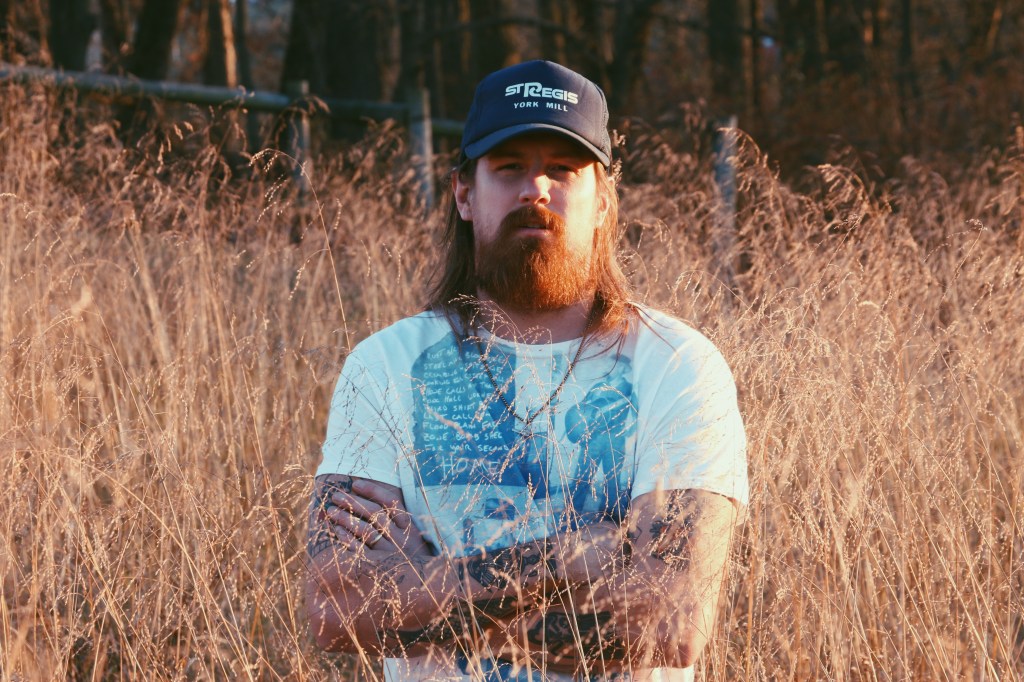
“I was there to play basketball primarily and then I was studying premedical biology,” he said. “But I also played a lot of music and was hanging out with all of the conservatory people when I was there.” That’s also where the first two PDP records were recorded.
“When I moved back, I kind of was hibernating away here doing woodchopping, rebuilding some of this place, and was thinking about hanging it up. It was kind of like what am I doing, what am I singing about?,” he added.
He started talking to Miller and played him some demos; the bassist dug them.
“I’m a fan of the band David (PDP’s guitarist) was in in Chicago, and then they had stopped playing,” he said. “So I sent him a message and I was like, hey man, we should hang out. Then he introduced me to Robby, who was his cousin.
“Ever since then, we’ve just become really good friends. We started feeling like a band, as opposed to me writing songs and sending them to my friends across the world. This is four people that contribute to the same mission,” he said.
In Everly’s case specifically (McCreary called him at once “an animal” and “the most mild, gentle person”), one band’s loss is absolutely PDP’s gain.
“(I learned that) some contemporaries, or even previous band leaders maybe, would give feedback or criticism to him that he kind of goes crazy or, quote unquote, overplays,” he said.
“The whole point of this band is to take the (bridle) off of the horse and let it run, and so Robby bringing metal blastbeats to my folk songs is just perfect,” he added with a broad grin.
McCreary’s day job is another, you guessed it, juxtaposition – this time between his folky roots and the very latest forms of technology. “I work for an international bank on the frontiers of AI, and have been integrating lots of different models of old legacy data into a Chat GPT integration that we have with that company,” he said. “Open AI is specifically who I’m working pretty closely with.”
Those folky roots are Pennsylvania Dutch, an ethnic group that came to this state (among others) from the Palatinate region in Germany during the 17th through 19th centuries. They have a long history of mysticism: there’s powwowing, the practice that combines healing charms and folk religion to treat illness or protect against harm; and hexing, which is the opposite of course, bringing harm, wishing ill.
And McCreary is fascinated with the dichotomy – yes, juxtaposition – of such an orthodox group of people being so open to the rather pagan idea of white and black magic.
“Within (this) album, I’m pointing to specific contradictions that happen within the liturgy and text that I was exposed to as a kid, growing up (Presbyterian) and then (going) to Wheaton and (studying) the NIV (New International Version, of the Bible) as if it was water itself,” he said.
“I really dove into the ritualistic healings of the Pennsylvania Dutch that some people might look at and be like that’s witchcraft or that’s some sort of spooky Wiccanism. That irony and juxtaposition – people just doing things to get through their day, like smearing mud on their face to take in the new moon – sounds as though it’s a scary thing to a practicing Presbyterian. But in reality it’s not that far off,” he added.
That exploration starts right off the bat with the rafters-shaking “Glossolalia,” which, in essence, means speaking in tongues. And it comes from personal experience.
“I have been exposed to very small amounts of actual glossolalia – other members of the band have participated in it and done it,” he said.
“If you were to hand that sort of practice to someone, they might think, oh, no. Whereas in the actual text, it is the conduit through which to speak that closely to God. So even though these things might seem strange or unorthodox or scary sometimes, the people that are doing it (are trying) to connect with something, to feel safe, worthy, and worthwhile,” he added. Not that he subscribes to it necessarily, he says.
“(In) trying to figure out what is the crux of some of the problems that are going on in the world, glossolalia as an example is a beautiful metaphor to help shepherd people down this sort of liturgical revelation,” he explains.
The heavy lyrical and sonic context of this opening track – which McCreary calls “me writing a riff that felt like probably the angriest thing I’d ever put to a guitar,” sets the stage for “later down the road to bend the body towards the light, (towards) understanding and acceptance and kindness and love and all of the good stuff.”
We’ll get to that later.
PDP’s heavy sonic soul comes from an unsurprising place.
“If you start thinking about metal, (Tony) Iommi getting his fingers sawn off and putting pieces of plastic on and playing guitar, that inherently is a sound that I like,” he said.
“‘Black Sabbath,’ the album, is the pinnacle. But then also sometimes Radiohead can also be heavy in a way that I also love and find myself running to. The fun playfulness of introducing a really heavy thing within some sort of transcendent major chord is exciting,” he added.
“Matthew 27:53” refers to the resurrection of Christ, but in the song, McCreary wonders what happened to the others who were also crucified that day. He asks, in one of many examples of his skilled wordplay, “Did they Lazarus themselves back down/Or did they raise like you say?”
“I can’t go back and talk to this long-dead apostle and be like, hey man, why didn’t you talk about all these other people who rose from the dead and walked around – it kind of cheapens the ascension of Christ and the resurrection. S’up with that?,” he quipped.
“How Many of You” touches on the suffering of women throughout time, especially in its poignant lines about St. Brigid of Kildare: “Tendered up my name/All the purity’s insane/The hagiography said she was a goddess.” Indeed she was, in the Celtic pantheon before Christianity.
“I was thinking about Fira (his younger daughter) specifically, because she’s kind of like asking these questions,” he said. “These doctrines and dogmas that we’ve instilled in humans have helped move things forward – the empowerment of women is one of them. But I believe there’s a lot of road to cover, obviously, in the current climate of that specific issue.”
“Of Hexel + Mummix” refers to a Pennsylvania Dutch recipe for leftovers – bits and bobs of other foods scrambled together to make a new dish. McCreary has a cookbook of those recipes.
“It’s one of those things that’s just of this area,” he said,
It also marks a thematic shift in the album.
“The previous song (‘How Many of You’) asks how many of you have actually gone down to … the river to pray,” he said. “It was this really kind of heavy thing that I thought needed some levity. (So) it’s the start of the turn.
“We have the things that are under our feet; we have the land that came before me. What are all those things about now? And how do they inform all of these things we just posed? I do think that we’re all the same; I do think that we are all part of something larger than ourselves. If one another is all we have, how do we start walking forward?,” he added.
As noted in the lyrical references, McCreary has a deep love of language and a sharp ear for a good play on words. He credits his wife, a writer herself, for much of that inspiration.
“We lived long distance when I was in Chicago, so we exchanged many, many letters,” he said. “I got really good at describing what was going on in my day-to-day and so did she.”
Another of Brittany’s linguistic traditions was “Seven Wednesday Words.”
“She would pick a random seven words and send it out to a mailing list of friends and family,” he said. “Everybody would write their own little poem or essay based on those seven words. It was so fun. I archived them for a long time and watched how other people played with words, or attempted to.”
But his biggest influence as a songwriter was the poet Charles Bukowski, whom he called “a miserable person, but a beautiful soul.”
“There’s a video of him heavily drunk on wine (and) he’s asked about another poet,” he said. “And he’s like, yeah, I’ve read him, but it doesn’t have anything dripping off of it.
“That has stuck with me for a long time. I do like these freeform, sing-song things when we’re recording, but if I’m going to commit to something, I want it to have meat on the bones. It should be as good to read as it is to sing. (And) I took really good care of the lyrics on ‘Benediction,’” he added.
Pennsylvania is an interesting – and often frustrating – state. It’s an interwoven blend of urban and rural, liberal and conservative. McCreary’s stomping grounds fall mainly in the latter of those, and “Lecture XII” is about “an archetypal person” of that area.
The song’s title is a reference to a lecture on saintliness that appears in William James’ book, “The Varieties of Religious Experience.”
“I sing, “Medicate with a Busch Light” – people around here get that, and I want them to feel good about that, like I’m with you,” he said. “But you have to still take the time to think about the fact that there are stones that were placed in the Susquehanna (River) by people that lived here thousands of years before you, that had no concept of what you decided to take pride in right now, in the sense of nationalism.
“Not that that’s a bad thing, (but) the point that I’m making is acceptance of others. Once you read about the land that’s under your feet, personally it’s been harder to feel as though it’s mine. That I think is where I think we can start stepping (forward) together,” he added.
The fiddle solo in that track is no gimmick. McCreary started training in the Suzuki method at age 3, learning sonatas and concertos at the knee of teacher Venona Detrick. He studied with her until he went to college. In the song’s spoken soliloquy, he recalls running into her in a local coffee shop after not having seen her for many years.
“She instilled in me the obsession of studying eight measures of music and try and perfect it,” he said. “She is magic. She got me to do things that I probably wouldn’t be able to do and had a relationship in alliance with my mom that aimed to challenge me and was very beautiful and steeped in nothing but love. It was just for the love of music and the love of a child.”
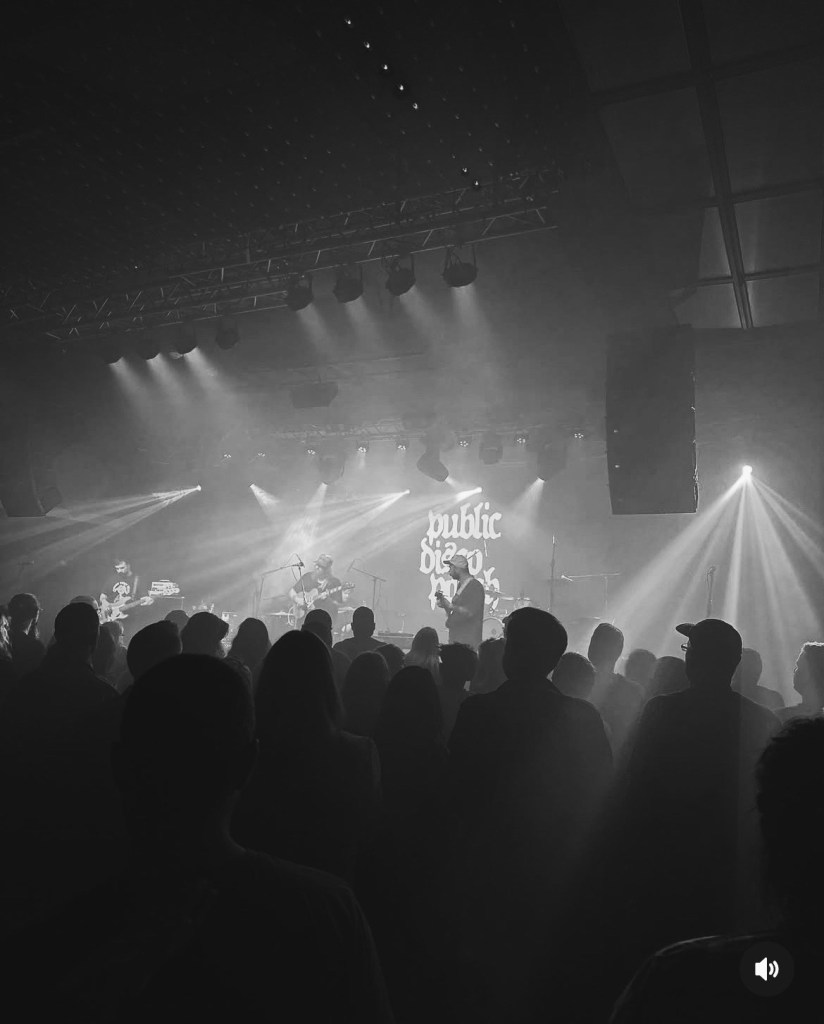
He especially enjoys the contrast of using both instruments live.
“That visual juxtaposition has been really exciting to play with,” he said. “You can be these characters in the moment of a set. It is very genuine – I want to play the violin as much as I want to play the guitar. But sometimes it’s harder to emote anger or frustration with a delicate wooden instrument than to kind of beat the shit out of an old guitar.”
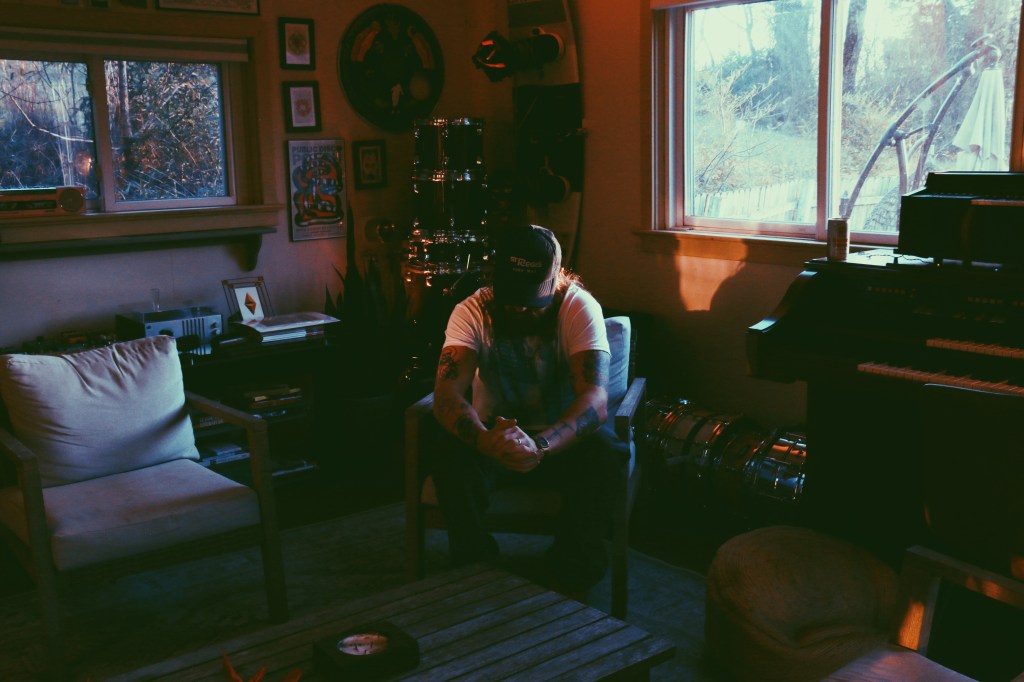
The album’s tone continues its shift with “Transcendence for Personal Healing.”
“It’s a lot more open-sounding and vibey,” McCreary acknowledged. “The whole idea was to instill a sense of acceptance, a little bit more gentle. There’s also this play of the first half of the album being this sort of Old Testament wrath and the second half is a little bit more chill.”
It’s again peppered with nods to Christ: “I am leaving, to learn my name/Is it all wilderness?/Let it consume me.” He says he was “reading a lot of the King James (Version) when I was writing it.”
“When we have all of these different practicing paths of thought, it’s all good when the taxes are paid and Thanksgiving dinner’s out and the family’s around,” he said. “But when some agony shows up, (it’s) ‘well, God works in mysterious ways.’ That for me has been really challenging – that’s the one strand that I’m still pulling, probably even into the records to come.”
It’s a damning of religion, too, when he asks, “Are you bending down to clean the gore … Or still calling for some other morgues/To be filled up in your name.”
“Asking that question is the only other logical thread to pull – we still have wars that are going on that are charged in the name of God, and land disputes,” he said. “I think that these are important things to be talking about, or at least shepherding out to the public sphere, small as it might be.”
The mantra that closes the album, “All of My Body,” nicely reprises one idea from the opener, “Glossolalia”: “say it in your tongue … let me fall out from etymology.”
But it’s really almost a clarification of himself.
“If I am going to condemn – if I am going to point out things and say here’s my take on it, and here are all of the things that I built up as a backbone to feel good about a condemnation – what do I believe in, then?” he said.
“Sitting at that organ, looking out that window. I see the sun as it sets in the summer. Get outside, feel the sun on your face, put your feet into the grass that has as much dominion over you as you have over it. Worshiping something other than yourself. That is us, and Andromeda that hangs above us. That’s what I’m here for,” added.
There have been plenty of other bands who’ve had success tackling the metaphysical, the philosophical – most recently, the ‘90s band Live, who was also from the York area. So if they can sing about the writings of the Indian thinker Krishnamurti and draw listeners, there has to be a wider audience for Public Disco Porch as well.
“I think we would agree, but that really hasn’t been the goal,” McCreary said. “Maybe that will change, but I recognize that it’s a pretty big swing, as far as like we’re making an album, titling an album as such, and then populating it with (the) songs that we just did isn’t the most immediately accessible thing.
“However, with that, I think that when the people that need something like that find it, it resonates on a level that they’re in for the long haul, and it feels like it’s meaningful as much as it is for us. Obviously there might be more people that want to hear a breakup song or something, maybe. I don’t know. I think it’s its own path,” he concluded.
-
Whispering Void, “At the Sound of the Heart”
Whispering Void, “At the Sound of the Heart” (Prophecy Productions)
Review by Kira L. Schlechter
As its creators have implied, “At the Sound of the Heart” is music for decompression. “Put your phone down,” they advise; listen to the sound of your heart, the blood in your veins, the call of nature. We are only here for an eyeblink before we are gone – we exist and then we don’t.
That is not to say that this album by Whispering Void – rather a supergroup of Norwegian alternative/extreme music – is wifty or wafty or New Age-y. Its makers all have heaviness at their cores and it seethes with that excitement. Anything ambient or proggy or psychedelic most often grows into an entity lashed with metal. Lyrics are in the group’s native tongue and in English.
Guitarist Ronny Stavestrand (Trelldom) created the music, and his collaborators – all from the west coast of Norway, as he is – brought their own formidable backgrounds to the project. Wardruna’s Lindy-Fay Hella and Kristian “Gaahl” Eivind Espedal sing (he was in Trelldom with Stavestrand and is of course also famed for his time in Gorgoroth).
Enslaved’s Iver Sandøy contributes his talent on drums and percussion, as well as on bass, guitar, and keyboards; he also recorded, mixed, and mastered the album. He said in a record label interview that he was sonically inspired by the late avant-garde musician Scott Walker, particularly his third album, “Scott 3.”
Guest musicians add their own touches: Ole André Farstad plays guzheng and Indian slide guitar; Matias Monsen plays cello; and Silje Solberg contributes the distinctive ambiance of Norway’s native hardanger fiddle.
“Vinden vier” (“The Wind Sanctifies” or “The Wind Unites”) is built on a winding, sinuous melody that starts on acoustic guitar. Layers build and drums are added, then the melody becomes electric as Lindy-Fay driftingly sings and Kristian chants breathily along to the tempo. This track really bears Iver’s stamp in many ways, from the open, airy drums-and-programming segment to the segue into a heavier, more thunderous portion to the deconstruction of the core melody at the end.
The stunning “Vi finnes” (“We Exist”) has Lindy-Fay and Kristian whispering the lyrics together to a light, rolling groove and a haunting guitar melody. In what could be considered a chorus, she breaks into the wordless singing she does so well and the melody and drumming intensify to glorious effect. It too has a quiet, measured portion before picking up the chorus section anew. Kristian tenderly repeats the line “Vi finnes aldri” (roughly, “we never exist”) as the music dies away, then Lindy-Fay’s melody is carried on and reworked by guitar. Do listen to this one; it’s superior.
Ronny’s melody starts “Whispering Void” as it has the previous tracks, aided by Ivar’s sensitive drumming; the two of them become decidedly heavier as the song takes hold. Kristian and Lindy-Fay are so tightly melded as to be almost indistinguishable on the vocals at first, then he repeats the opening lines in almost spoken-word fashion before singing them in a near monotone. A delicate guitar, like a light breath, then a crescendo of drums lead to the final section. Its rhythm unrelenting, its mix dense, it has both singers delivering evocative lines like “Walking from the now/walking through the sound” again in unison before gently falling into an almost music-box rendition of the melody to end.
Ronny’s melancholic acoustic melody undulates throughout the first part of the title track as Lindy-Fay croons wordlessly and Kristian whispers. Those lovely guitar textures segue into an almost sinister, foreboding cello solo as Iver picks up with more insistent drumming. The lot rises dramatically into electric guitar, bass, and Iver’s syncopated groove as Kristian mutters what’s really the album’s ultimate goal: to be “here within the void … at the sound of the heart,” that is, to reach introspection and reflection.
The evocative instrumental “Lauvvind” is this project most perfectly realized musically – simple picking, a languid groove led by bass, touches of electronic percussion, then a crescendo into a headbanging-worthy ending.
“We Are Here” may begin with cello and ever-so-light percussion, but it’s really notable for Ronny’s deceptively simple guitar melody, one that acts as a touchstone across the track – before a drift of fiddle and Kristian repeating its only lyrics (“We are here/Within the voices/We are here/Within the void”), then chiming along to Iver’s march-style drumming, and then floating beneath in the ether under a chaotic, almost black-metal breakdown. It reprises finally at the end to no other accompaniment.
The closing piece, “Flower,” seems to coalesce everything this project was meant to achieve. It’s built again on Ronny’s shifting melodies, with wordless vocals so closely blended tonally that they become genderless and Iver’s scattershot, jazz-like low-end drum commentaries. Kristian speaks the meditative lyrics – “Where is the morning/Where are the rays of light/Where are the flowers/And the colors of life” – and that question is answered by that same blending of vocals, male and female: “This is the morning/This is the rays of light.”
“At the Sound of the Heart” is a jewel, a collaboration that brings together each of its parts into a whole that is so innately harmonious, it’s as if it was of one singular mind. Like its mission, it too exists for this moment alone and it is precious for its fleeting nature.


About Me
Sometimes the hardest part of finding success is gathering the courage to get started. The most successful people don’t look back to see who’s watching. Look for opportunities to lift others up along the way.
Follow Me On
Subscribe To My Newsletter
“Do not say a little in many words but a great deal in few.” – Pythagoras

